

Owning a vacation rental in Minnesota comes with real tax obligations that many property owners overlook. The state’s property taxes and income requirements can be confusing, especially when you’re managing seasonal income and multiple deductions.
We at Up North Property Management help owners navigate these rules every day. This guide breaks down what you actually owe, what you can deduct, and the mistakes that cost owners money.
What You Actually Owe on Rental Income
If you rent your Minnesota vacation property for more than 15 days per year, the IRS requires you to report all rental income on your tax return using Schedule E rental income reporting requirements. This is non-negotiable. The 15-day threshold matters because it determines whether the property qualifies for personal-use treatment under IRS Publication 527. Once you cross 15 days of rental activity annually, you must report every dollar of income and can deduct legitimate expenses against it.
The federal tax rate on this income depends on your total income and filing status, ranging from 10% to 37% for the 2025 tax year. Minnesota adds state income tax on top of that, with rates between 5.35% and 9.85%, meaning combined federal and state rates can easily exceed 40% for higher earners. This is why meticulous record-keeping separates owners who pay thousands more than they should from those who keep their tax bills reasonable.
Deductions That Actually Matter
The IRS allows you to deduct mortgage interest, property taxes, insurance, utilities, cleaning supplies, repairs, and depreciation on the rental portion of your property. Depreciation deductions on rental property buildings stands out as the deduction most owners miss: you can depreciate the building value (not the land) over 27.5 years, which creates a substantial annual deduction even if you’re cash-flow positive. If your property is worth $400,000 and the building represents $300,000 of that value, you’re looking at roughly $10,900 per year in depreciation deductions.
The catch is that depreciation recapture applies when you sell, meaning you’ll owe tax on those deductions at a 25% rate, but that’s a problem for future you. Expenses must be ordinary and necessary to be deductible, so luxury improvements don’t qualify, but replacing a worn deck absolutely does. You must allocate expenses between rental and personal use based on actual days used; if you rent 200 days and use the property personally 60 days, roughly 77% of expenses are deductible. Keeping sloppy records here costs owners real money because the IRS doesn’t accept rough estimates.
Documentation That Protects You
Track every rental day, every expense receipt, and every dollar of income separately. Create a spreadsheet or use accounting software like QuickBooks Self-Employed that categorizes income and expenses by type. The IRS expects to see proof of rental activity: booking confirmations, guest logs, and payment records from platforms like Airbnb or Vrbo. For expenses, maintain receipts for repairs, cleaning, supplies, and property management fees.
Bank statements showing deposits and payments serve as backup documentation. The IRS audits rental properties at higher rates than W-2 income, so documentation that can withstand scrutiny protects you. Keep records for at least three years, though seven is safer. If you can’t prove a deduction, you lose it, which means a $5,000 repair expense becomes $2,000 in additional taxes at a 40% marginal rate.
Why Professional Help Matters
Poor documentation has cost owners more than the cost of hiring a tax professional to review their return. A qualified tax preparer identifies deductions you miss and structures your records to survive an audit. Property managers who handle rental operations also create audit trails through their invoices and reports, which strengthens your documentation. The investment in professional guidance typically pays for itself through deductions you wouldn’t have claimed otherwise.
Your property’s tax classification and local obligations add another layer of complexity that affects your overall tax position.
How Vacation Rental Properties Get Classified and Taxed
Minnesota classifies vacation rental properties differently than owner-occupied homes, and this classification directly impacts your annual tax bill. Vacation properties fall into Class 2a seasonal residential property, which carries significantly higher tax rates than homestead-classified owner-occupied homes. The county assessor determines your property’s assessed value during official assessment cycles using market data and comparable property sales in your area. This means a vacation rental worth $400,000 in the same neighborhood as a $400,000 homestead will owe substantially more in annual property taxes purely because of classification. Your annual tax bill includes levies from schools, cities, counties, and special districts, and rates vary dramatically by location. A property in one county might face a 1.2% effective tax rate while an identical property 30 miles away in another county faces 1.8%, creating thousands of dollars in annual difference based solely on geography.
The Homestead Exclusion Gap
The homestead market value exclusion available to owner-occupied homes does not apply to vacation rentals, which eliminates a substantial tax break. For homesteads valued at $95,000 or less, the homestead market value exclusion is 40% of market value, creating a maximum exclusion of $38,000. As property values rise above $95,000, the exclusion declines by 9% of the value over that threshold, phasing out entirely at $517,200. A homestead worth $280,000 receives a $21,350 exclusion, lowering the taxable market value to $258,650, while your vacation rental at the same price receives zero exclusion and owes taxes on the full $280,000. This exclusion difference alone costs vacation rental owners $2,500 to $4,000 annually depending on local tax rates and property value.
You cannot convert a vacation property to homestead classification while renting it regularly. The property must serve as your principal residence with genuine occupancy. Minnesota’s definition requires the property to be physically occupied as your primary home, eliminating vacation rentals from consideration regardless of rental frequency.
Understanding Your Local Tax Obligations
Your specific tax obligations depend entirely on where your Minnesota vacation property sits. If you rent directly to guests without using a marketplace like Airbnb or Vrbo, you must register with the Minnesota Department of Revenue and collect lodging taxes from guests. The state sales tax applies to all lodging-related charges including the room rate, cleaning fees, pet fees, and extra guest charges, but cancellation fees are not taxable while no-show charges are. On top of state sales tax, your county and city may impose additional local lodging taxes, and rates vary considerably. The Minnesota Department of Revenue’s lodging tax lookup for your specific address reveals your required registrations and total tax rate to collect.
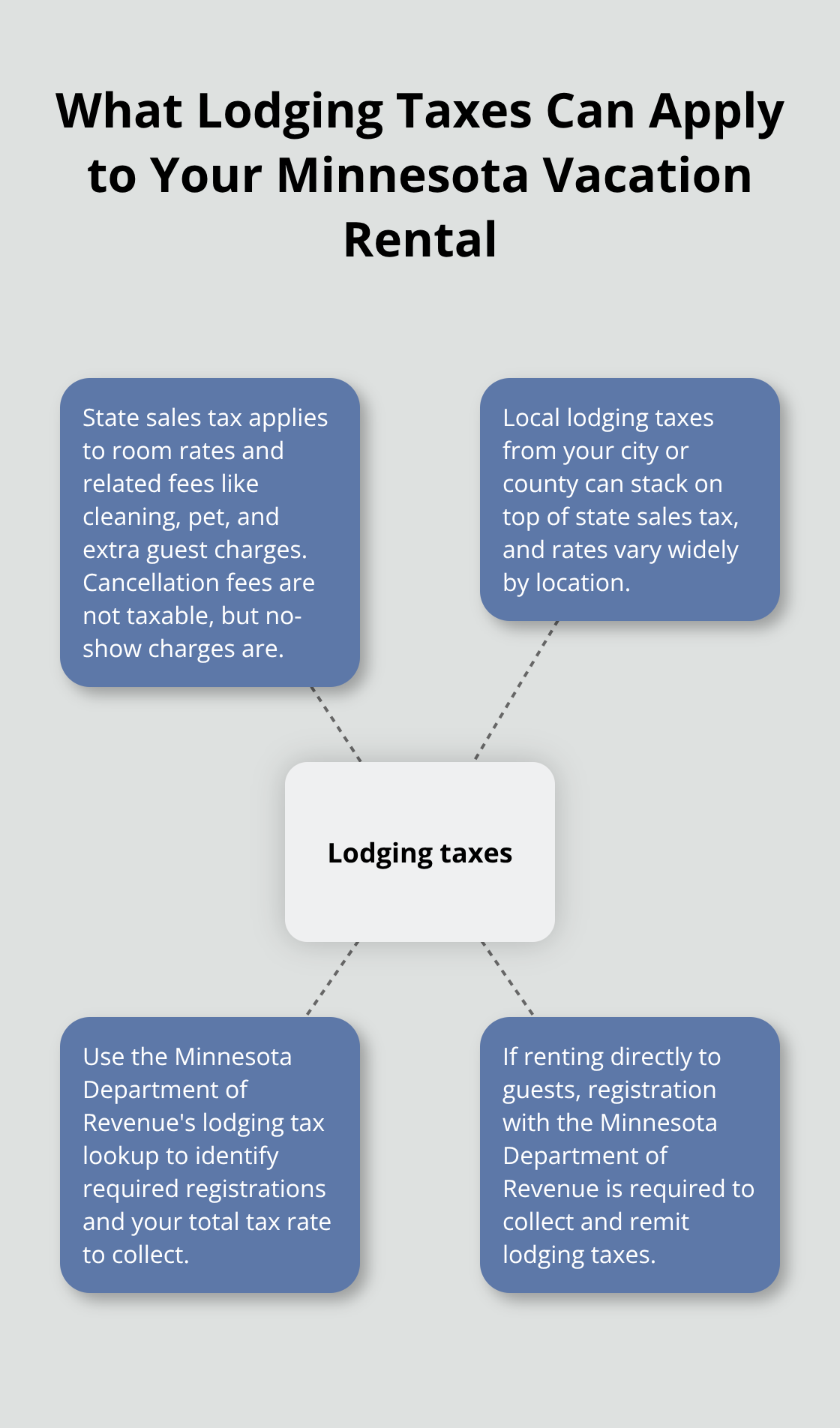
A property in Duluth faces different tax obligations than one in Brainerd, and rates change frequently enough that last year’s rate report may not reflect current requirements.
Filing Requirements and Deadlines
After registering, you must file returns with the state monthly, quarterly, or annually depending on your rental volume. Filing a zero-dollar return is required even when you didn’t rent during the period, and missing deadlines triggers penalties and interest that accumulate quickly. If a marketplace collects taxes for you, verify which taxes are actually covered because many platforms handle state sales tax but skip locally administered taxes, leaving you responsible for collection and remittance.
Consequences of Noncompliance
Noncompliance with Minnesota’s lodging tax requirements is increasingly pursued because municipalities depend on this revenue. Late filings incur penalties and interest that compound monthly, and some jurisdictions pursue legal action against delinquent operators. A Voluntary Disclosure Agreement with the Minnesota Department of Revenue allows you to disclose prior tax liabilities and potentially waive penalties and interest, but this only works if you initiate contact before the state identifies the issue. Owners who manage rentals independently often discover years later they owed taxes they never collected from guests, creating unexpected five-figure bills. The simplest approach involves using accounting software like Avalara’s MyLodgeTax to track rates and obligations by location, ensuring you collect the correct amount from every guest. Your county assessor’s office can clarify your property’s classification and explain how local levies affect your specific tax bill, providing clarity that prevents costly mistakes down the road.
These tax obligations represent just one piece of the puzzle-many vacation rental owners make critical mistakes that cost them thousands in unnecessary taxes and penalties.
Where Vacation Rental Owners Lose Money to Taxes
The IRS reports that rental property owners face audit rates three to four times higher than typical taxpayers, and the mistakes that trigger those audits follow predictable patterns. Owners lose thousands annually when they treat their vacation rental income casually, miss obvious deductions, or mishandle the income timing that comes with seasonal rentals. These aren’t theoretical problems-they’re concrete financial damage that compounds year after year.
Income Reporting Mistakes That Invite Audits
Many owners assume that if a marketplace like Airbnb or Vrbo handles the payment, they don’t need to track anything separately. This assumption is dangerously wrong. Those platforms report your gross income to the IRS on Form 1099-K, and the IRS matches that number against what you report on Schedule E. If you report $45,000 in income but Airbnb reports $50,000, the IRS notices the discrepancy and initiates an audit. You owe taxes on every dollar the platform reports, not what you think you earned after expenses.
The fix is straightforward: reconcile your platform reports against your Schedule E before filing, and document where money went if any portion wasn’t actually rental income. Some owners receive payments through personal bank accounts or Venmo from guests who pay outside the platform, and these payments vanish from any official record unless you manually track them. The IRS expects you to report all rental income regardless of how you receive it, and failing to do so creates audit risk that multiplies if the state also investigates your lodging tax compliance.
The Deduction Side: Where Real Money Disappears
Many owners claim only obvious expenses like mortgage interest and property taxes, completely missing that guest linens, light bulbs, air filters, landscaping maintenance, and plumbing repairs are all deductible. These small expenses add up to $3,000 to $6,000 annually on a typical vacation rental, representing $1,200 to $2,400 in tax savings at a 40% marginal rate. Owners who don’t track actual rental days versus personal use days also overstate deductions, claiming 100% of expenses when they used the property personally 80 days per year-a mistake that invites IRS scrutiny.
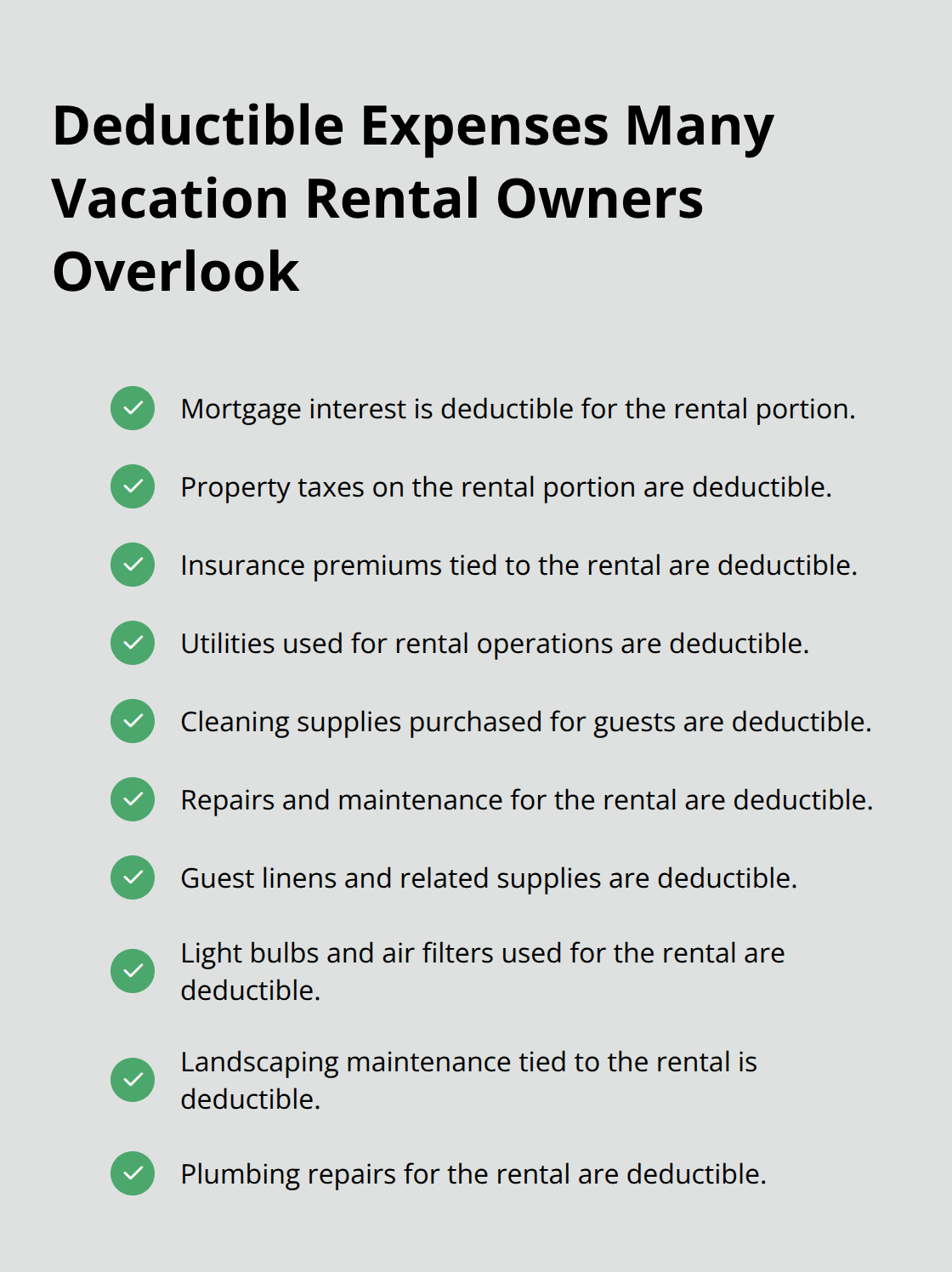
The allocation calculation requires honest counting: if you rented 220 days and used it personally 50 days out of 365 total days, then roughly 60% of expenses are deductible, not 100%. This precision matters because the IRS audits rental properties at higher rates than W-2 income, and documentation that can withstand scrutiny protects you. Keep records for at least three years, though seven is safer. If you can’t prove a deduction, you lose it, which means a $5,000 repair expense becomes $2,000 in additional taxes at a 40% marginal rate.
Seasonal Income and Tax Bracket Mistakes
Seasonal income creates a separate category of mistakes because many owners cluster their rental income into specific months, creating the false impression they have a low-income year when they actually have concentrated high income. A property that rents exclusively June through August generates $30,000 in income across three months, pushing you into a higher tax bracket despite earning the same $30,000 you would if it were spread across twelve months. You cannot retroactively smooth income to a different year, but you can plan deductible expenses strategically-scheduling major repairs or roof maintenance in high-income months reduces the bracket impact of concentrated seasonal earnings.
Owners who fail to plan this way overpay federal and state income taxes by $1,500 to $4,000 annually depending on their total income and state residence. The solution involves working with a tax professional in January or February to project your year’s rental income and plan deductible expenses accordingly, rather than discovering in April that you owed substantially more than anticipated. A qualified tax preparer identifies deductions you miss and structures your records to survive an audit, and the investment in professional guidance typically pays for itself through deductions you wouldn’t have claimed otherwise.
Final Thoughts
Minnesota vacation rental taxes involve three interconnected layers: federal and state income tax on rental earnings, property taxes based on Class 2a classification, and lodging taxes collected from guests. Missing any layer costs you money through overpayment, penalties, or audit exposure. The mistakes that cost owners the most money follow predictable patterns-failing to reconcile platform income reports against tax filings, missing deductible expenses that add up to thousands annually, and mishandling seasonal income concentration that pushes you into higher tax brackets.
These errors compound year after year, turning a $2,000 annual mistake into $10,000 in cumulative overpayment within five years. A tax professional who understands vacation rental operations identifies deductions you’d miss alone and structures your records to withstand audit scrutiny. Your county assessor can clarify your property’s classification and explain how local levies affect your specific property taxes, while the Minnesota Department of Revenue’s lodging tax lookup reveals your exact obligations by location.
We at Up North Property Management handle the operational side of vacation rentals, managing marketing, bookings, cleaning, and maintenance so your property stays in top condition and generates consistent income. When you partner with a property manager, you gain detailed invoices and reports that create audit trails strengthening your tax documentation. Visit Up North Property Management to learn how full-service management simplifies your rental operations while protecting your tax position.