
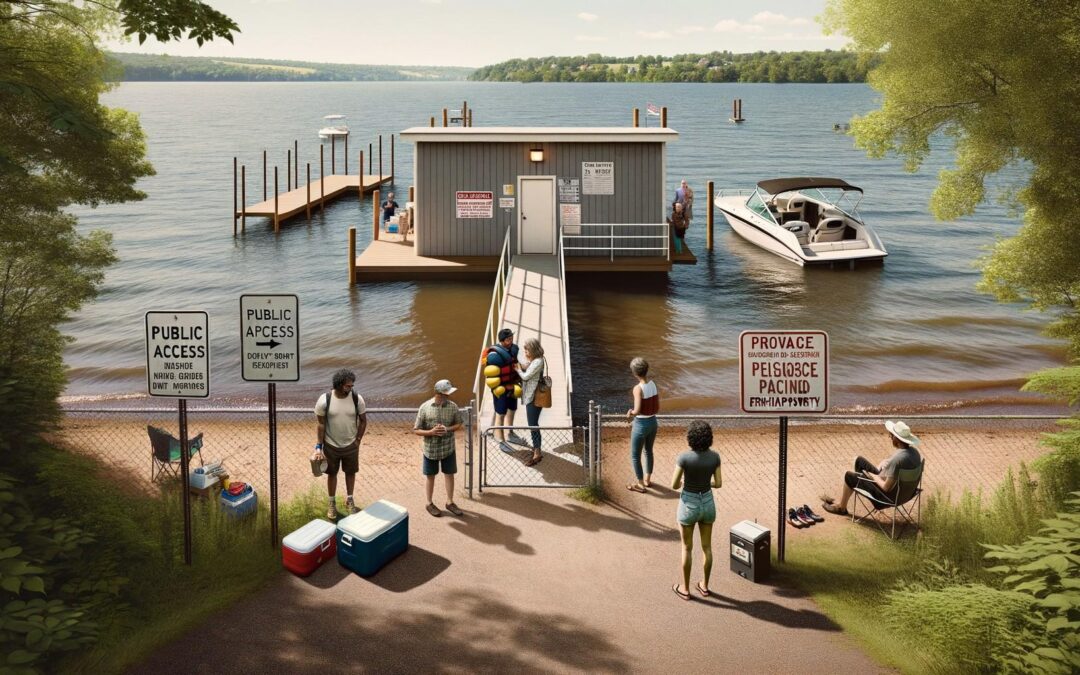
Minnesota’s lake access rules are confusing. Property owners, renters, and visitors often disagree about who can fish, swim, or boat on a particular lake.
Here at Up North Property Management, we’ve seen these disputes firsthand. The difference between public and private lake access determines your rights-and it’s not always obvious which category your lake falls into.
How Minnesota Classifies Lake Access Rights
Minnesota’s lake access rules hinge on one critical distinction: whether a lake qualifies as public water under state law. This classification doesn’t depend on who owns the land around it. Instead, the Minnesota Department of Natural Resources applies specific legal criteria outlined in Minnesota Statute 103G.005 to determine public water status. Lakes larger than 10 acres in unincorporated areas, navigable waters, meandered lakes designated on historic surveys, and watercourses with drainage areas exceeding 2 square miles all qualify as public waters. The state oversees roughly 11,000 lakes larger than 10 acres, which means most Minnesota lakes fall under public water regulations. However, this doesn’t mean the shoreline itself is public property.
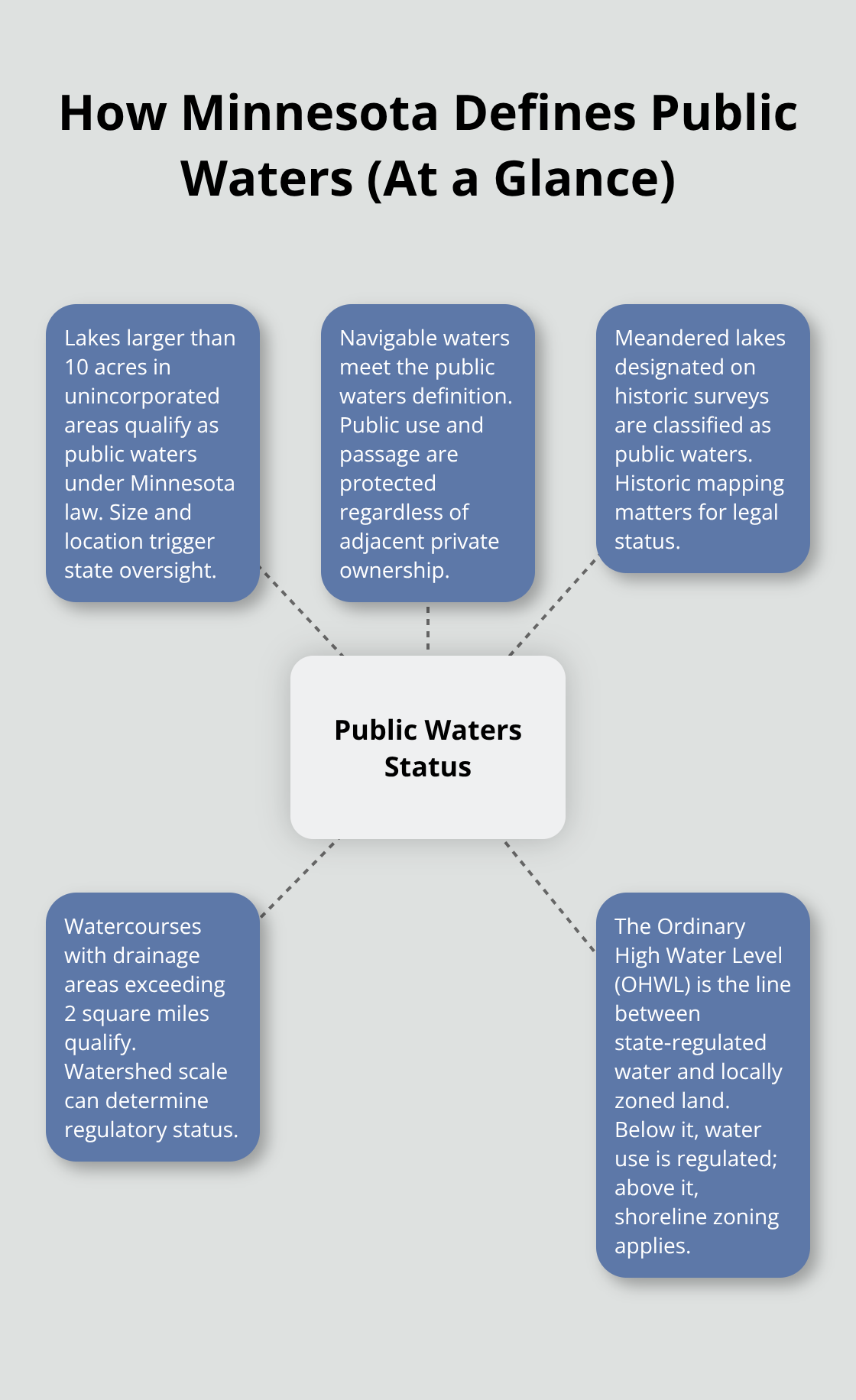
The Ordinary High Water Level defined in Minnesota Statute 103G.005 marks the boundary between what the state regulates as water (below) and what local zoning controls as land (above). Below that line, riparian owners hold specific rights. Above it, local zoning applies to their property. This distinction matters enormously for dock construction, water access, and property disputes.
What Riparian Ownership Actually Means
If you own land that touches a public water body in Minnesota, you hold riparian rights, not unlimited control. These rights allow you to use the water surface reasonably for boating, swimming, and fishing. You can construct a dock to navigable depth under Minnesota court precedent established in LMCD v. Canning (2004), which ruled that local governments cannot prohibit docks outright, though they can regulate them. Riparian owners cannot dike off, drain, or fence portions of a waterbody in ways that interfere with public passage, as this violates Minnesota Statute 609.74. Your riparian rights extend only to the thread, or centerline, of non-navigable streams, and to navigable depth on navigable waters. Non-riparian property owners have no legal right to cross private land to access water, even if the lake is public. This constitutes trespass under Minnesota law. Property deeds and historical surveys determine the boundary between your riparian rights and your neighbor’s rights, not what feels fair or reasonable.
Finding Out If Your Lake Is Actually Public
Contact the Minnesota DNR at 888-646-6367, 651-296-6157, or email dnrpublicwaters@state.mn.us to confirm whether a specific lake qualifies as public water. Use the DNR’s Lake Finder tool to search the waterbody and check its water access status. County-level water access maps (available free) help you identify public launch points versus private shoreline. If you’re considering property purchase or have an access dispute, a Minnesota water-law attorney can review your deed and the DNR’s Public Waters Inventory to clarify your exact rights. Don’t rely on assumptions or what neighbors claim. The DNR maintains official records that settle these questions definitively.
What Happens When You Own Riparian Property
Riparian ownership comes with both privileges and strict limitations. You gain the right to wharf out to navigable depth, take water for domestic and agricultural purposes, and use ice, fish, boat, hunt, and swim on the water surface. However, you must exercise these rights reasonably and cannot interfere with other riparian owners’ rights. The courts have consistently upheld this balance. If you plan to add a dock, build a boathouse, or modify your shoreline, you’ll need to work within the OHWL framework and comply with local permits. Many disputes arise because property owners assume their land ownership extends underwater or that they can restrict public water use. Minnesota law rejects both assumptions.
Moving Forward With Your Lake Access Questions
Understanding whether your lake is public or private, and what rights you actually hold, requires checking official sources rather than relying on local knowledge or deed language alone. The next section covers how public boat launches operate and what free access points the state maintains across Minnesota.
How to Access Minnesota’s Public Waters
Minnesota maintains roughly 90,000 miles of shoreline across its 11,000 lakes larger than 10 acres, yet most people have no idea where they can legally access it. The Minnesota Department of Natural Resources operates a straightforward system: public waters remain open to everyone, but you must reach them through designated public access points. These access points include boat ramps, carry-in launches, public beaches, and parks-not through private shoreline. The state maintains these facilities specifically so you avoid asking riparian owners for permission to fish, swim, or boat on public waters.
Where You Can Launch Your Boat
Public water accesses operate 24 hours a day unless posted otherwise, and the DNR charges no launch fees at most locations unless the site sits within a park requiring a vehicle permit. Most public ramps accommodate boats between 12 and 18 feet long, though some handle larger vessels. Before launching, check the DNR’s Lake Finder tool to verify the access point’s current status and water conditions for your specific lake.
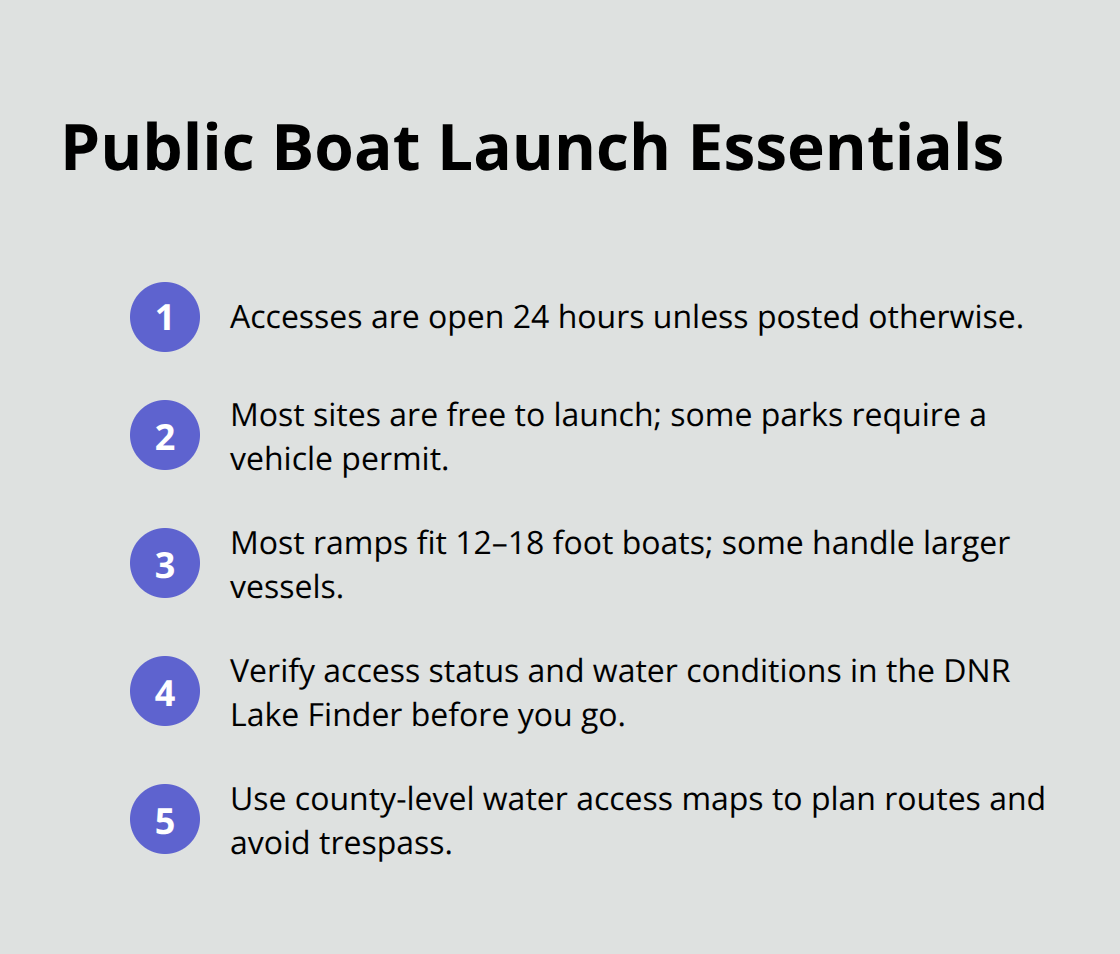
County-level water access maps (available free from the DNR) help you plan ahead and distinguish public launches from private shorelines, preventing wasted trips and trespassing mistakes.
Proper Launch Techniques Protect Everyone
The DNR strongly discourages powerloading-the practice of backing a boat fully into the water to load gear-because it damages ramps and creates safety hazards for other users. Load your boat after launching in the designated water area instead. Check seasonal water levels before launching to protect both the ramp and your equipment, particularly in spring when ice-out conditions vary widely across the state. Winter and early-spring launches require checking statewide ice-out tracking data provided by the DNR to avoid dangerous conditions.
Safety and Licensing Requirements
Life jacket regulations apply on all public waters: Minnesota law mandates that all watercraft have a U.S. Coast Guard-approved Personal Flotation Device for each person on board, and the DNR offers proper fitting guidance to ensure your PFD works if you go overboard. Fishing on public waters demands a valid Minnesota fishing license, with season and bag limits set by the DNR for each waterbody. These rules protect both you and the fish populations that future anglers will enjoy.
Getting Help With Access Questions
Contact the DNR at 888-646-6367 or 651-296-6157, or email dnrpublicwaters@state.mn.us with questions about specific access points or whether a lake qualifies as public water. The agency maintains official records that answer these questions definitively. Once you understand where you can access public waters, the question shifts: what happens when you own riparian property on a lake, and how do those ownership rights interact with public access?
What Rights Do You Actually Have as a Riparian Owner
Owning land on a Minnesota lake sounds straightforward until you try to exercise your rights. Riparian rights are property rights arising from owning shoreland and include the right to wharf out to a navigable depth and to take water for domestic purposes. You can construct a dock to navigable depth, take water for domestic and agricultural purposes, and use the water surface for boating, swimming, fishing, hunting, and ice activities. The Minnesota Court of Appeals settled the dock question definitively in LMCD v. Canning (2004), ruling that local governments cannot prohibit dock construction outright, though they retain authority to regulate design and placement. This precedent matters because it protects your ability to build water access infrastructure on navigable waters.
Where Your Riparian Rights End
Your riparian rights stop at the thread of non-navigable streams and at navigable depth on navigable waters. You cannot extend your control beyond these boundaries, and you absolutely cannot dike off, drain, or fence portions of the waterbody in ways that block public passage. Landowners who fence their waters or shorelands can be prosecuted under the Water Safety Act and/or the Public Nuisance Law. The courts treat riparian rights as a balance: you gain access and use privileges, but you must exercise them reasonably without interfering with other riparian owners’ identical rights.
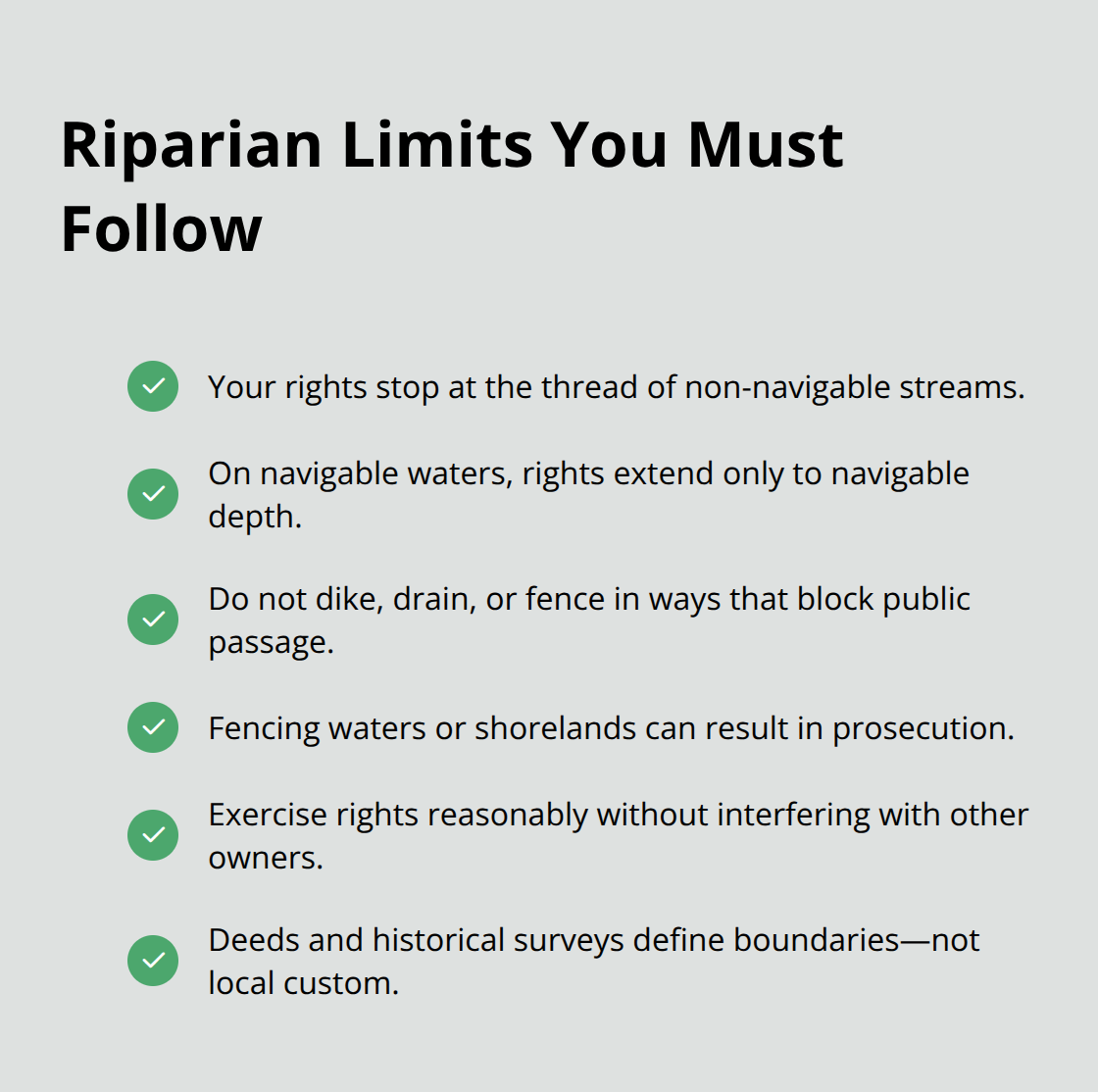
If a neighbor’s dock blocks your water access or your swimming area, Minnesota water law provides remedies. Property deeds and historical surveys determine the boundary between your riparian rights and your neighbor’s rights, not what seems fair or what local custom suggests.
Private Land and Public Water Access
Your riparian rights do not extend to private land. Non-riparian property owners have zero legal authority to cross your property to reach the water, even if the lake itself is public. This is trespass under Minnesota law, and you can legally prevent it. Conversely, you cannot cross someone else’s private land to access a public water body. The only legal path to public waters runs through designated public access points maintained by the DNR. This distinction creates real challenges for landlocked property owners who want water access, which is why easements and formal access agreements exist.
Easements and Access Agreements
An easement is a legal right to use someone else’s land for a specific purpose, such as reaching the water. These agreements must be recorded in the county deed records to be enforceable, and they typically require compensation to the riparian owner. If you inherited property with unclear access rights or you’re considering purchasing a lake home, hire a Minnesota water-law attorney to review your deed against the DNR’s Public Waters Inventory. The cost of a legal review now prevents costly disputes later. Many property disputes arise because owners assume their deed grants them something it does not, or they rely on informal understandings with neighbors instead of recorded agreements. Courts enforce recorded easements and formal access agreements; they do not enforce handshake deals or long-standing practice without documentation.
Final Thoughts
Minnesota’s lake access rules rest on one fact: public waters belong to everyone, but private shoreline belongs to riparian owners. The distinction between these two categories determines whether you can fish, swim, or boat on a lake without permission. Contact the Minnesota DNR directly at 888-646-6367, 651-296-6157, or dnrpublicwaters@state.mn.us to determine your lake’s classification, and use the Lake Finder tool to verify its public water status.
If you own riparian property or plan to purchase lakefront land, hire a Minnesota water-law attorney to review your deed against official DNR records. This investment prevents misunderstandings about your actual lake access rights and obligations. County-level water access maps show exactly where public launches exist versus private shoreline, helping you understand what you can and cannot do on your property.
Access disputes arise when property owners rely on assumptions instead of official sources. Courts enforce recorded easements and formal agreements, not informal understandings or long-standing practice without documentation. If you own vacation rental property on Minnesota’s lakes, Up North Property Management handles the operational complexity so you focus on ownership and maximize your lakefront investment’s income potential.