
Lakefront properties offer stunning views and peaceful living, but they face a serious threat: lake erosion. Water, soil, and weather work together to wear away your shoreline year after year.
At Up North Property Management, we’ve seen firsthand how erosion can damage foundations, destroy landscaping, and reduce property values. The good news is that proven prevention methods can stop erosion before it becomes expensive.
What Causes Lakefront Erosion
Water wave action remains the primary erosion driver on lakes. Waves constantly move soil particles, even on calm days when you might not notice obvious water movement. Steeper slopes and longer lake banks accelerate this damage because runoff travels faster down inclines, carrying more sediment away from your shoreline. Research from the National Oceanic and Atmospheric Administration shows that wave energy dissipates across gentle slopes but concentrates on steep banks, making slope angle critical to erosion rates. A shoreline slope maintained at four feet horizontal to one foot vertical or gentler reduces erosion risk significantly compared to steeper configurations. If your property has a slope steeper than this ratio, erosion will outpace natural stabilization every year.
How Rainfall Intensity Drives Seasonal Damage
More frequent and intense rainfall directly increases shoreline erosion and suspended sediment in lake water. Heavy storms push stormwater runoff with pollutants into your lake, disturb topsoil, and raise water levels unnaturally high. This combination accelerates erosion faster than gradual water action alone. Seasonal changes amplify the problem because spring snowmelt and summer thunderstorms create temporary spikes in runoff volume. Soil composition matters enormously here. Sandy or silty soils erode far faster than clay-heavy compositions, and loose topsoil offers almost no resistance to water movement. If your shoreline has exposed topsoil without vegetation cover, erosion accelerates dramatically during wet seasons.
Why Native Vegetation Prevents Bank Failure
Native vegetation on your shoreline anchors soil through root systems that stabilize banks. Roots act as anchors that hold soil in place even when water pressure increases. Native vegetation should cover soil from the water’s edge to provide robust stabilization. Without this buffer, unchecked erosion reduces reservoir storage and water supply capacity while undermining your property’s foundation over time. Construction, paving, and farming activities disturb topsoil and eliminate protective vegetation, escalating erosion risk substantially. Human activities that remove shoreline cover represent the fastest way to transform minor erosion into major property damage.
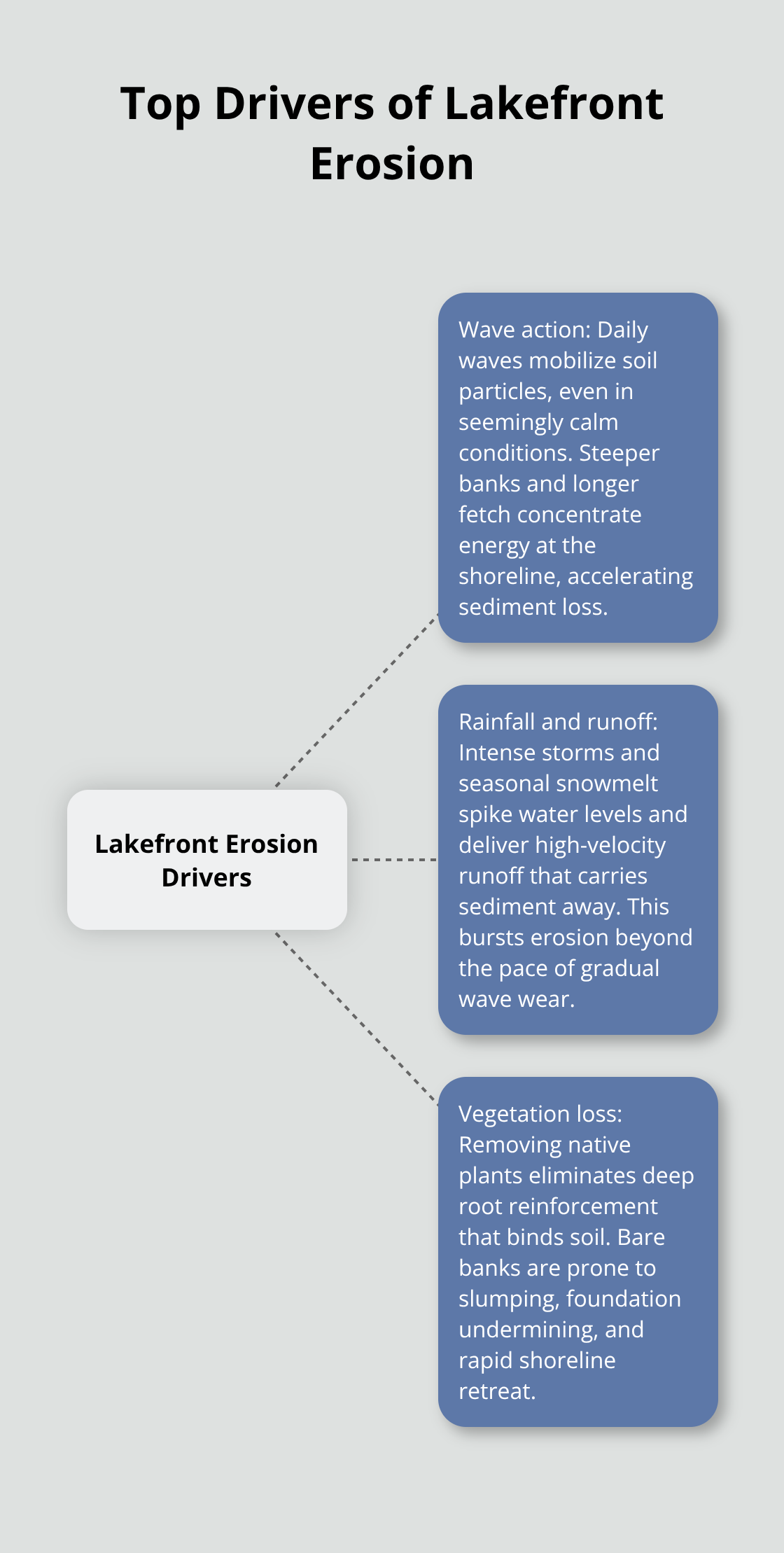
Understanding these three erosion drivers-wave action, rainfall patterns, and vegetation loss-helps you identify which threats affect your specific property most. The next section covers the proven methods that stop erosion before it reaches your home.
Stopping Erosion Before It Reaches Your Home
Native Vegetation as Your First Defense
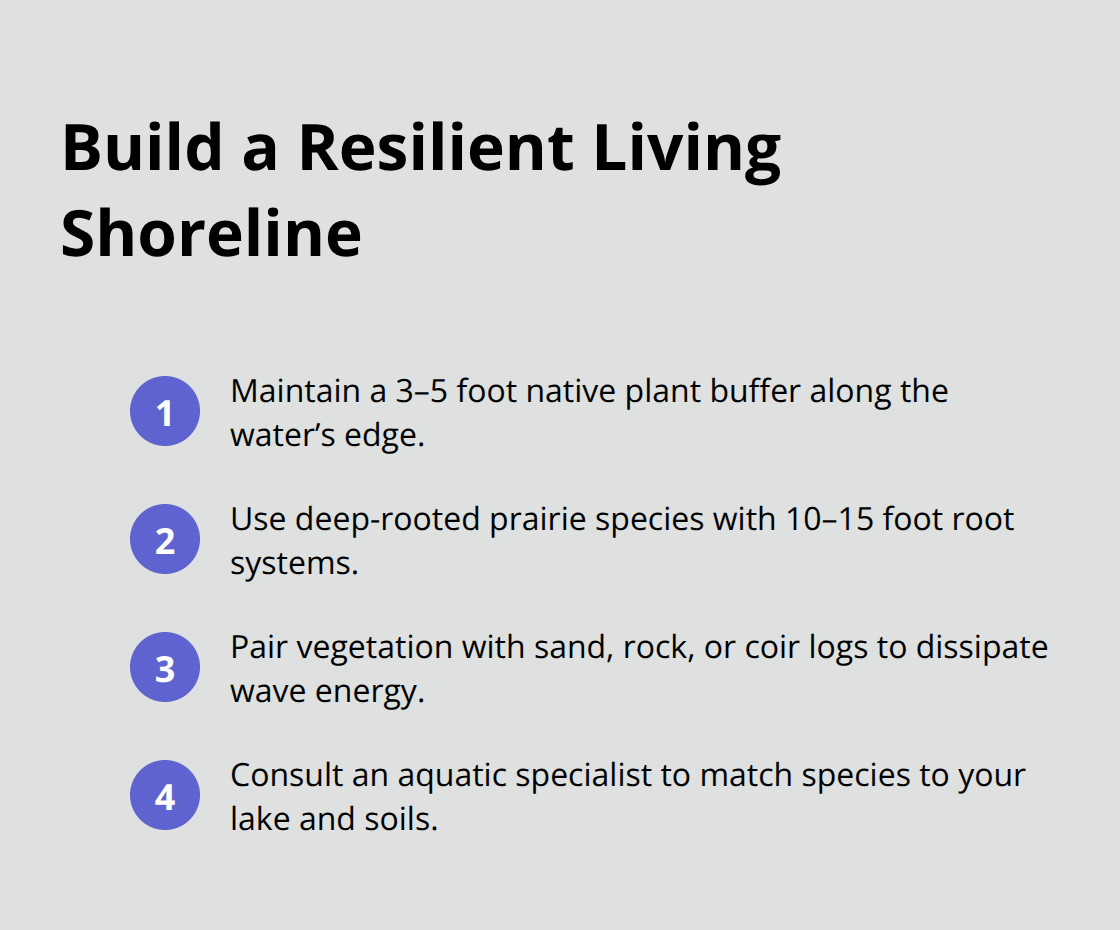
Vegetation stands as the most cost-effective erosion defense, and native plants must cover soil three to five feet from the water’s edge to anchor banks effectively. Native prairie plants have roots that can extend 10 to 15 feet deep, stabilizing soil far better than shallow-rooted ornamental plants, and you should start with deep-rooted annual grasses suited to your climate to provide immediate protection while trees establish themselves over years. The National Oceanic and Atmospheric Administration emphasizes that living shorelines-which combine native vegetation with natural materials like sand, rock, or coir logs-outperform hardened structures during major storms and typically cost less to install and maintain than concrete seawalls. If your shoreline currently lacks vegetation cover, this is the first problem to solve because exposed topsoil erodes dramatically faster than vegetated banks. You should consult an aquatic specialist to identify which native plant species thrive in your specific lake environment and soil type, ensuring vegetation fully covers the vulnerable zone near the water line.
Riprap Systems for Steeper Shorelines
Riprap systems work when vegetation alone cannot stabilize your shoreline, particularly on slopes steeper than the ideal four-to-one ratio. Riprap costs between $150 to $800 per linear foot, depending on stone type and site difficulty, with hand-placed installations reaching higher costs in challenging terrain. Fieldstone runs $65 to $105 per cubic yard while granite costs $65 to $100 per cubic yard, so you should select durable stone within your budget. You must place riprap over protective blankets or erosion-control nets rather than directly on soil, as this pairing dramatically increases durability and prevents water from flowing between rocks and pulling soil away. Riprap lifespan reaches 70 to 100 years with proper installation and maintenance, making it far more durable than temporary fixes.
Maintenance and Professional Assessment
For shorelines with trees, steep slopes, or high wave energy, you should expect costs around $400 per linear foot and plan for annual inspections plus occasional weed management at $30 to $300 per quarter-acre. Seawalls and bulkheads offer the strongest protection but require professional design and installation with deep excavation for proper drainage and correct backfill materials. You should address erosion early through professional shoreline assessment to prevent progressive damage to your home foundation and determine whether vegetation, riprap, or hardened structures best suit your property’s specific conditions. The right solution depends entirely on your slope angle, soil type, wave energy, and budget-factors that vary dramatically from one property to the next. Your next step involves identifying which erosion control method matches your shoreline’s unique characteristics and your long-term maintenance capacity.
Long-Term Maintenance and Monitoring Strategies
Erosion control does not end after you install riprap or plant vegetation. These solutions require consistent attention to remain effective, and neglecting maintenance accelerates damage far faster than the original erosion problem. Property owners often underestimate the time commitment required to protect lakefront investments, but annual inspections catch problems before they become expensive repairs.
Schedule Inspections Before and After Peak Seasons
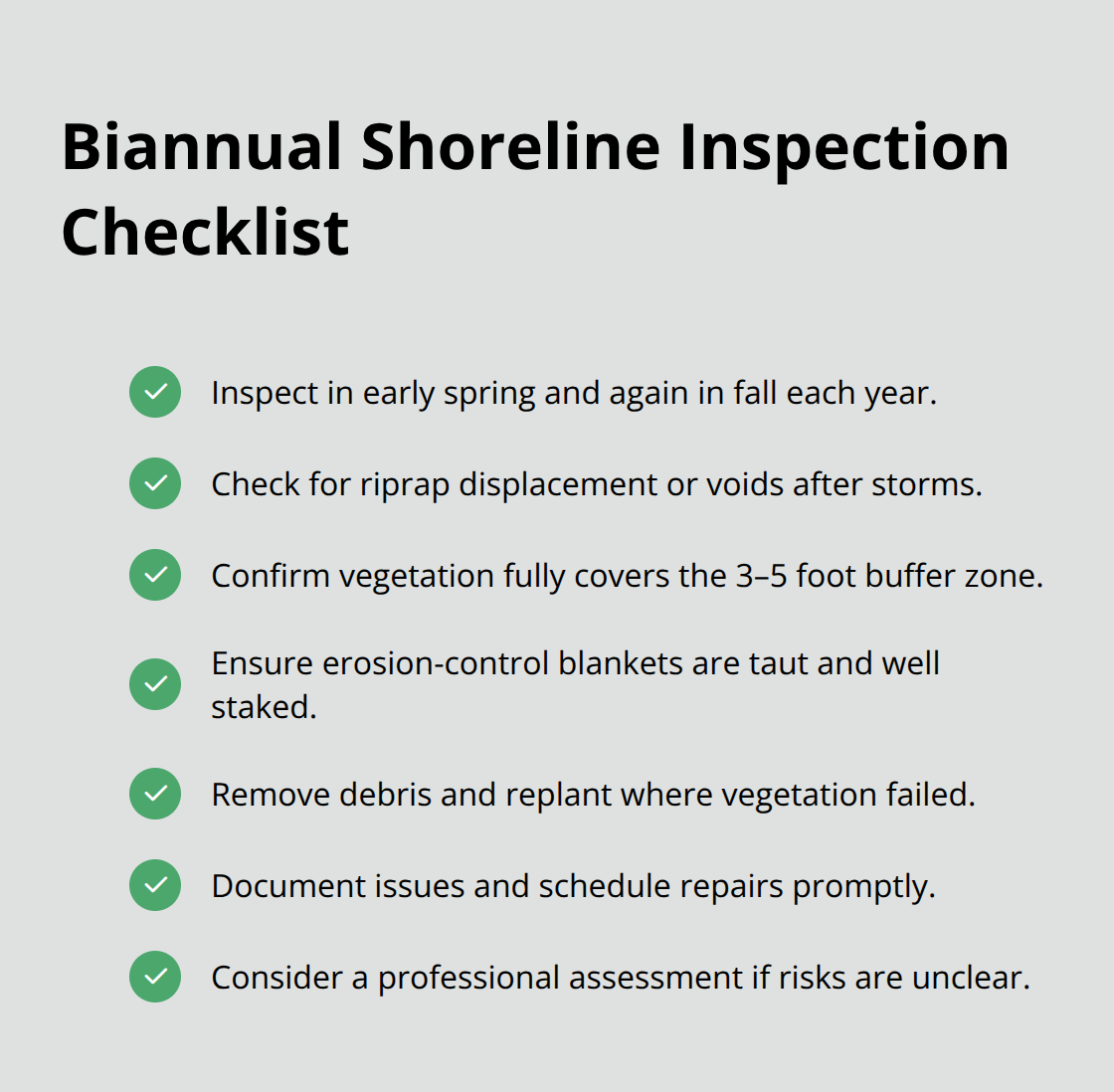
Schedule inspections in early spring before heavy runoff season and again in fall after summer storms have passed. During spring inspections, look for soil displacement around riprap, check that vegetation covers the three-to-five foot buffer zone near the water’s edge, and verify that erosion control blankets remain taut and properly staked. Fall inspections should focus on storm damage assessment, debris removal from protected areas, and identifying where vegetation failed to establish so you can replant before winter. These two inspections per year cost nothing if you perform them yourself, but many lakefront owners hire professional shoreline specialists for $800 to $5,500 in site assessment fees because professional evaluations identify problems invisible to untrained eyes.
Address Weed Management and Storm Damage Promptly
Weed management around riprap and vegetation areas demands attention every quarter, costing $30 to $300 per 0.25 acre depending on infestation severity. If storm damage occurs, address repairs immediately at $100 to $250 per linear foot because delayed repairs allow water to exploit cracks and accelerate foundation undermining. Bulkhead rock and seawalls are a short-term erosion control method with long-term impacts on your property, neighboring properties, and the water’s ecosystem.
Prepare Your Shoreline for Winter and Spring Transitions
Seasonal preparation differs dramatically between regions, but all lakefront properties require pre-winter and post-winter protocols. Before winter arrives, remove debris that collects around riprap and vegetation, trim dead branches from native plants to prevent ice damage, and verify that drainage systems function properly so snowmelt flows away from your shoreline rather than concentrating water pressure on vulnerable banks. After winter, inspect for frost heave damage that displaces riprap, check that ice action did not dislodge protective blankets, and evaluate whether erosion accelerated due to freeze-thaw cycles.
Maintain Native Vegetation and Monitor Riprap Integrity
Native vegetation maintenance includes removing invasive species that destabilize banks and burrowing wildlife that tunnels through soil, weakening structural integrity. Lifespan of well-maintained riprap reaches 70 to 100 years, but this durability only materializes with proactive monitoring and prompt repairs. Professional erosion control specialists bring expertise that identifies site-specific problems before they escalate, understand local permitting requirements that protect you from costly enforcement actions, and possess equipment access for large-scale repairs that homeowners cannot manage independently. The investment in professional guidance typically prevents far larger expenses down the road because specialists recognize erosion patterns and recommend interventions at optimal timing rather than reactive repairs after damage spreads.
Final Thoughts
Protecting your lakefront property from lake erosion requires action, not hope. The methods we’ve covered-native vegetation, riprap systems, and professional monitoring-work because they address the root causes of erosion rather than treating symptoms after damage spreads. Starting with vegetation costs nothing if you plant it yourself, but waiting until erosion undermines your foundation costs tens of thousands in repairs.
Your shoreline’s condition today determines your property’s value and safety tomorrow. Erosion accelerates exponentially once it begins, meaning a small problem ignored becomes a catastrophic one within years. Annual inspections catch problems early when solutions remain affordable and effective, and storm damage repairs delayed by even one season allow water to exploit cracks and spread damage across your entire shoreline.
If you own a lakefront property in Northern Minnesota, Up North Property Management handles the full-service management that keeps vacation rental properties in top condition, from maintenance coordination to seasonal preparation. We at Up North Property Management recognize how freeze-thaw cycles, spring runoff, and seasonal storms affect shorelines specifically in your region, and we can help you schedule a professional shoreline assessment to identify your slope angle, soil type, and current vegetation coverage. Start your erosion protection plan this season and commit to annual inspections and prompt repairs.