
Most property owners treat rental management as a back-office function. We at Up North Property Management believe that’s a mistake.
Marketing-focused rental management isn’t optional-it’s the difference between properties that sit empty and those that generate consistent income. Properties with aggressive marketing strategies outperform their competitors by significant margins, and direct bookings cut commission costs that eat into your profits.
Why Marketing Matters More Than You Think
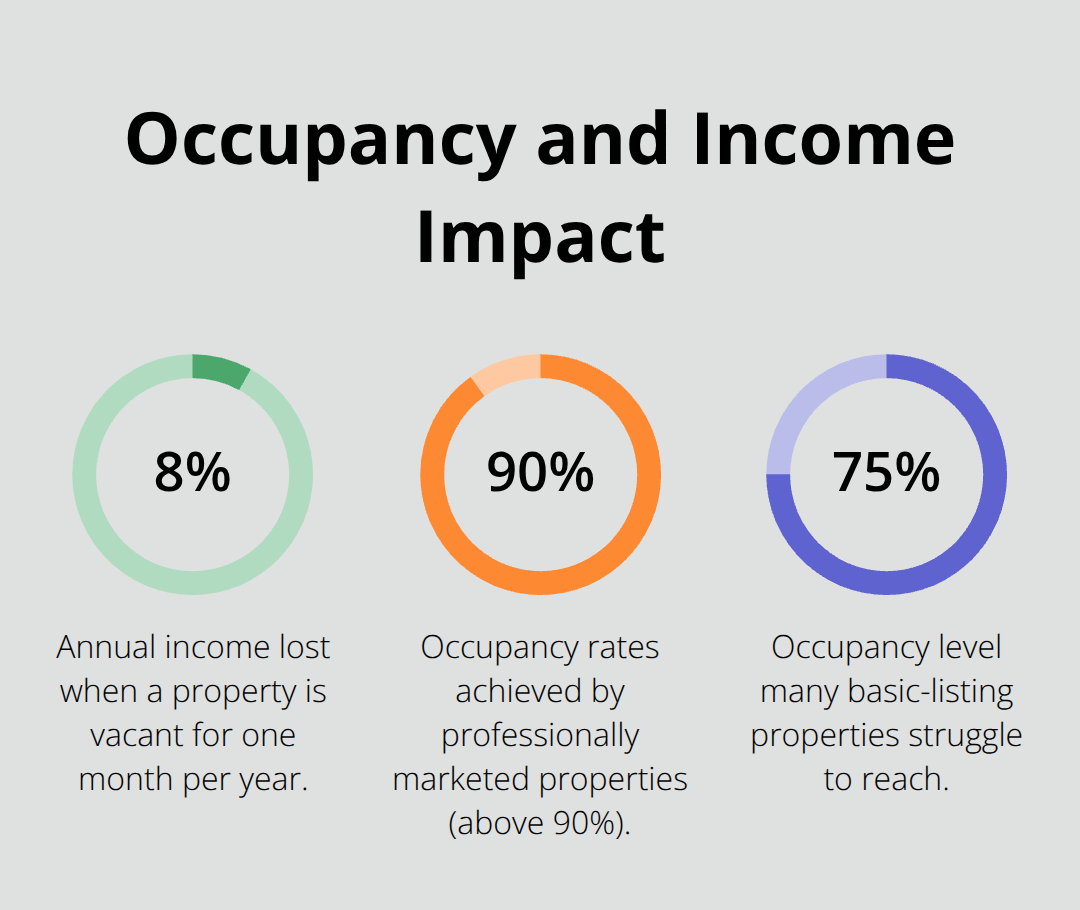
The rental market has fundamentally shifted. Properties that rely on passive listings and hope tenants find them sit empty far more often than those with aggressive marketing strategies behind them. According to Coherent Market Insights, the global property management market reached USD 26.30 billion in 2026, with apartments and condos accounting for 37.2% of that revenue. This growth reflects a simple truth: professionally managed properties with strong marketing strategies capture market share from those without it. When a property sits vacant for even one month per year, you lose roughly 8% of potential annual income. The difference between 85% occupancy and 95% occupancy isn’t just 10 percentage points-it’s the difference between breaking even and building real wealth. Properties that invest in professional marketing, high-quality photography, and multi-platform listing distribution consistently achieve occupancy rates above 90%, while properties relying on basic listings struggle to reach 75%.
Direct Bookings Eliminate Commission Drain
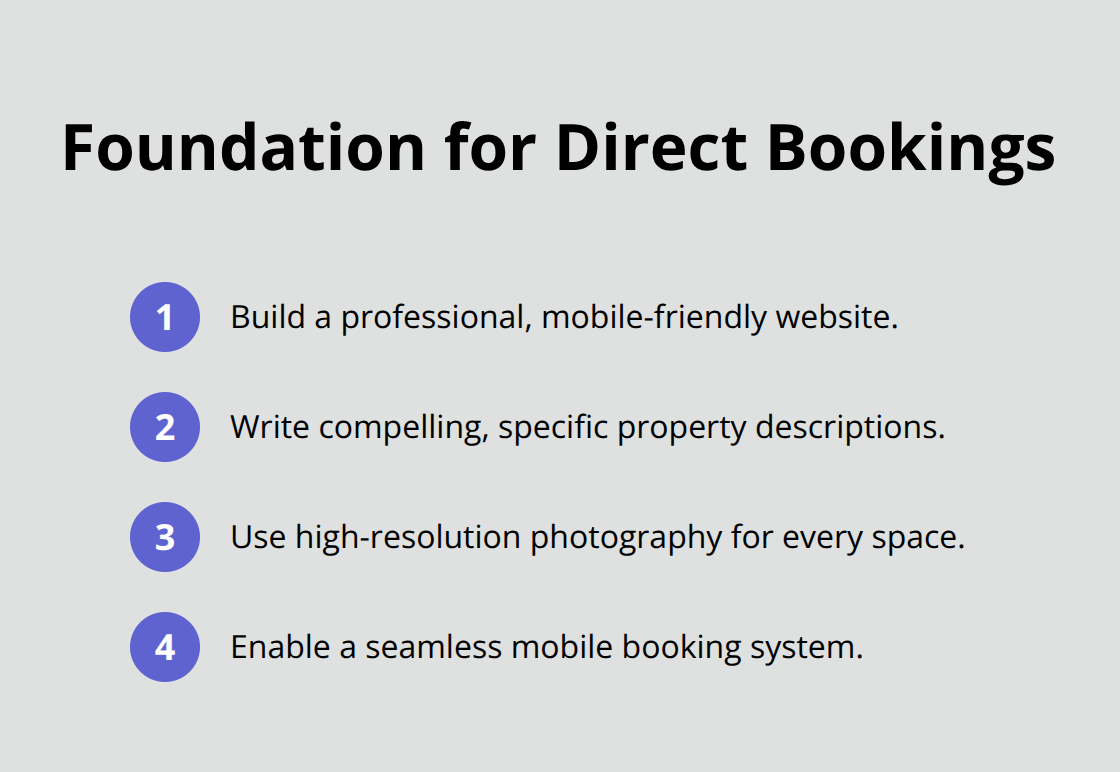
Direct bookings represent your path to higher margins and stronger guest relationships. When guests book through platforms like Airbnb or Vrbo, you pay commission fees ranging from 3% to 5% of your total revenue. A property generating $50,000 annually loses $1,500 to $2,500 in commissions alone. Direct bookings eliminate these fees entirely, putting that money straight into your pocket. A professional website, compelling property descriptions, high-resolution photos, and a seamless mobile booking system create the foundation for direct bookings. Properties that successfully drive 30% to 40% of their bookings directly see immediate increases in net income.
Market Growth Rewards Active Marketing
The short-term rental market in North America is valued at $14.32 billion and projected to reach $21.53 billion by 2026, according to market research. This growth goes to properties that actively market themselves. Your competitors are capturing this expansion. Properties that implement strategic pricing based on local demand, seasonal trends, and competitor rates maximize revenue per booking while maintaining healthy occupancy. Dynamic pricing tools that adjust rates based on real-time market conditions can increase annual revenue by 15% to 25% without adding operational burden.
Visibility Across Channels Drives Bookings
Consistent visibility across multiple channels directly correlates with higher occupancy rates and shorter vacancy periods. Properties listed on 10 or more platforms generate 40% more inquiries than those on just one or two platforms. When potential guests search for rentals in your area, your property needs to appear across Google search results, major listing aggregators, and social media platforms. Properties that maintain active social media presence, regularly update their listings with fresh photos and accurate availability, and respond quickly to inquiries convert interested prospects into confirmed bookings at significantly higher rates. The data is clear: properties that appear first in search results and across multiple channels secure bookings faster and command higher nightly rates. Guests trust properties with consistent visibility because visibility signals that a professional manages the property and takes guest experience seriously.
This foundation of aggressive marketing, direct bookings, and multi-channel visibility sets the stage for the next critical decision: knowing what to look for when selecting a property manager who actually prioritizes these strategies.
How Aggressive Marketing Transforms Your Rental Income
Professional photography and listing optimization form the foundation of income growth. When potential guests search for rentals, they make split-second decisions based on visual first impressions. Poor lighting, cluttered rooms, or low-quality images send them clicking to competitors. A professional photographer costs between $300 and $800 for a full property shoot, but properties with professional photos command higher nightly rates because guests perceive them as better maintained and more trustworthy.
Photography and Descriptions That Convert Browsers Into Bookers
Listing optimization requires writing descriptions that highlight specific amenities guests actually search for: high-speed Wi-Fi, full kitchens, parking, proximity to attractions, and workspace. Generic descriptions like “cozy cabin” convert poorly, while detailed descriptions like “fully equipped kitchen with dishwasher and gas range, dedicated workspace with high-speed fiber internet, private parking for two vehicles, 10 minutes from downtown shops” directly address what different guest segments need. Properties that update photos quarterly and refresh descriptions seasonally maintain higher booking momentum throughout the year.
Multi-Platform Distribution Captures 40% More Bookings
Distributing your property across 10 or more platforms generates substantially more inquiries than relying on one or two channels. Major platforms like Airbnb, Vrbo, and Booking.com each attract different guest types and search behaviors. Airbnb dominates younger travelers and international guests, while Vrbo attracts families and longer-stay renters. Booking.com reaches corporate travelers and last-minute bookers. A property listed only on Airbnb misses entire guest segments.
Syndication services that distribute listings to 30+ platforms simultaneously, including Zillow, Trulia, and Apartments.com, eliminate manual posting and maintain consistent property information across channels. Real-time synchronization prevents double bookings and keeps availability current across all platforms. Direct bookings through your own website represent an additional revenue channel that requires minimal commission. A mobile-friendly website with compelling photos, guest reviews, and a simple booking system captures guests who want to bypass platform fees and book directly.
Dynamic Pricing Extracts Maximum Revenue Without Guesswork
Dynamic pricing based on real-time demand and seasonality ensures your vacation rental prices remain competitive and aligned with market conditions. Properties that set one nightly rate year-round leave substantial money on the table during peak seasons and struggle to fill vacancies during slow periods. Dynamic pricing tools analyze historical booking patterns, local events, competitor rates, and upcoming demand to automatically adjust prices.
A property in a ski region should charge significantly more during winter months and holidays. The same property during shoulder seasons might require lower rates to maintain occupancy. Event-based pricing capitalizes on local conferences, festivals, and attractions that drive temporary demand spikes. A property near a major venue hosting a sold-out concert or sporting event can charge 50% to 100% premiums for those specific dates.
Competitor benchmarking prevents underpricing. If comparable properties in your area charge $150 per night and yours charges $120, you leave $900 to $1,200 per week uncaptured. Tools that track competitor pricing in real time allow rate adjustments within hours of market shifts. The combination of professional presentation, broad distribution, and intelligent pricing creates a self-reinforcing cycle: higher visibility attracts more inquiries, better pricing converts inquiries into bookings, and strong occupancy rates justify premium nightly rates.
This foundation of professional marketing positions your property to compete effectively. The next step involves selecting a property manager who actually executes these strategies with precision and accountability.
What to Look for in a Marketing-First Property Manager
Occupancy Performance Reveals True Marketing Capability
The difference between a property manager who handles basics and one who transforms your rental income lies in three measurable areas: occupancy performance data, the technology stack they deploy, and how they allocate support resources. Most property managers claim to market properties, but few can show concrete occupancy improvements or explain which tools they actually use.
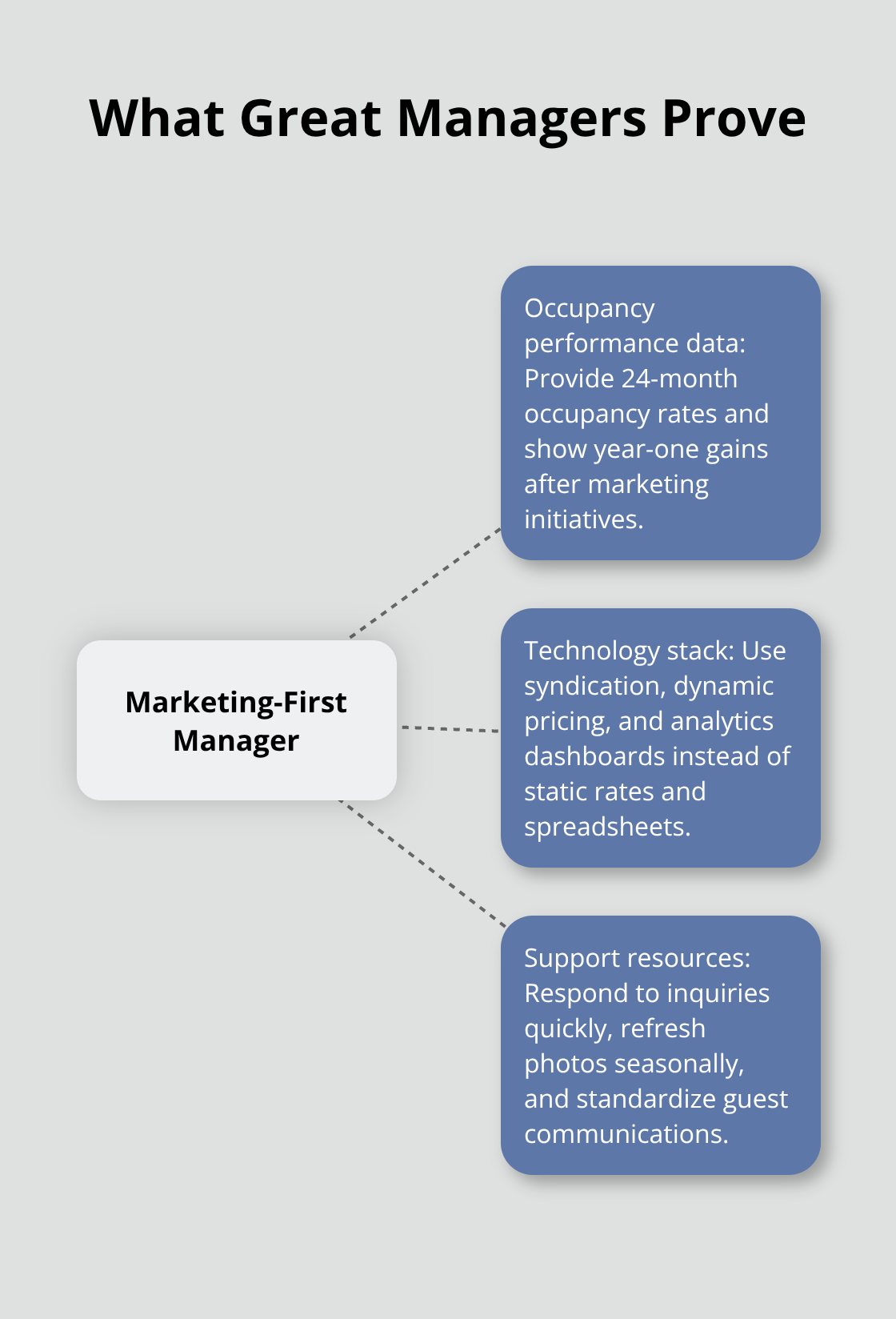
Start by requesting occupancy rates for their current portfolio over the past 24 months. A manager focused on marketing should demonstrate average occupancy rates of 90% to 95% across their portfolio. Ask specifically: what percentage of their properties achieved occupancy above 90% last year? What was the average occupancy for properties under 12 months of management versus those managed for 3+ years? Managers without this data are guessing about performance rather than tracking it.
Occupancy improvement should accelerate after the first 6 months as marketing strategies take hold. Properties should see 5% to 10% occupancy gains in year one when switching to a marketing-focused manager. If a manager cannot produce these specific numbers or explains away poor performance with generic market conditions, their marketing focus exists in marketing materials only, not in actual operations.
Technology Infrastructure Separates Effective Managers from Mediocre Ones
Technology separates effective managers from mediocre ones. A quality manager uses syndication platforms that distribute listings to 30+ channels simultaneously, preventing manual posting errors and ensuring consistency across Airbnb, Vrbo, Booking.com, Zillow, and secondary platforms. They implement dynamic pricing tools that adjust rates based on real-time demand, competitor analysis, and local events rather than static annual rates.
Real-time dashboards track occupancy, average daily rate, and revenue per available night to enable data-driven decisions instead of assumptions. Ask what booking and marketing tools they use and request access to sample owner dashboards showing property performance metrics. Platforms like Hemlane, Buildium, or similar comprehensive systems indicate infrastructure investment. Managers still using spreadsheets and email updates operate at 1990s efficiency levels and cannot compete in today’s market.
Support Resources and Guest Experience Standards
Evaluate how they allocate support beyond routine maintenance. Marketing-focused management requires rapid response to inquiries, professional guest communication, and seasonal listing updates with fresh photography. Ask how quickly they respond to guest inquiries during peak seasons and whether they conduct quarterly photo updates. Do they hire professional photographers or use phone snapshots?
Professional managers invest in quarterly photography at $300 to $800 per shoot because it directly impacts booking rates and nightly rates. They maintain detailed guest communication templates and track response times as a performance metric. Properties managed by someone treating it as part-time work or dividing attention across 100+ units cannot deliver the guest experience that drives repeat bookings and positive reviews.
A marketing-first manager typically carries 20 to 40 properties maximum, allowing dedicated attention to each property’s strategy and guest experience. This portfolio size ensures that your property receives the focused effort required to compete effectively in competitive markets and capture the occupancy rates that generate sustainable income.
Final Thoughts
The rental market rewards property managers who treat marketing as a core business function, not an afterthought. Marketing-focused rental management separates properties that generate consistent 90%+ occupancy from those that struggle to fill calendars. The difference isn’t luck or market conditions-it’s strategy, execution, and accountability.
Your property deserves a partner who prioritizes guest acquisition through professional photography, multi-platform distribution, and dynamic pricing. These aren’t optional upgrades; they form the foundation of competitive performance in a market where visibility translates directly to bookings and revenue. A manager who cannot demonstrate occupancy improvements, lacks modern technology infrastructure, or spreads attention across too many properties will not deliver the results your investment requires.
Higher occupancy rates justify premium nightly rates, positive guest reviews attract more inquiries, and direct bookings eliminate commission drain. Professional presentation builds guest trust, and each element reinforces the others to create a self-sustaining cycle of growth. Contact Up North Property Management to explore how marketing-focused management transforms your rental income.