Minnesota lakefront vacation rentals attract serious money. Properties on the water command premium rates because demand stays strong year-round while inventory remains tight.
We at Up North Property Management have seen firsthand how owners leave thousands on the table through poor pricing, weak marketing, and maintenance gaps. This guide shows you exactly how to avoid those mistakes and build a profitable rental operation.
Why Waterfront Homes Command Premium Rates in Minnesota
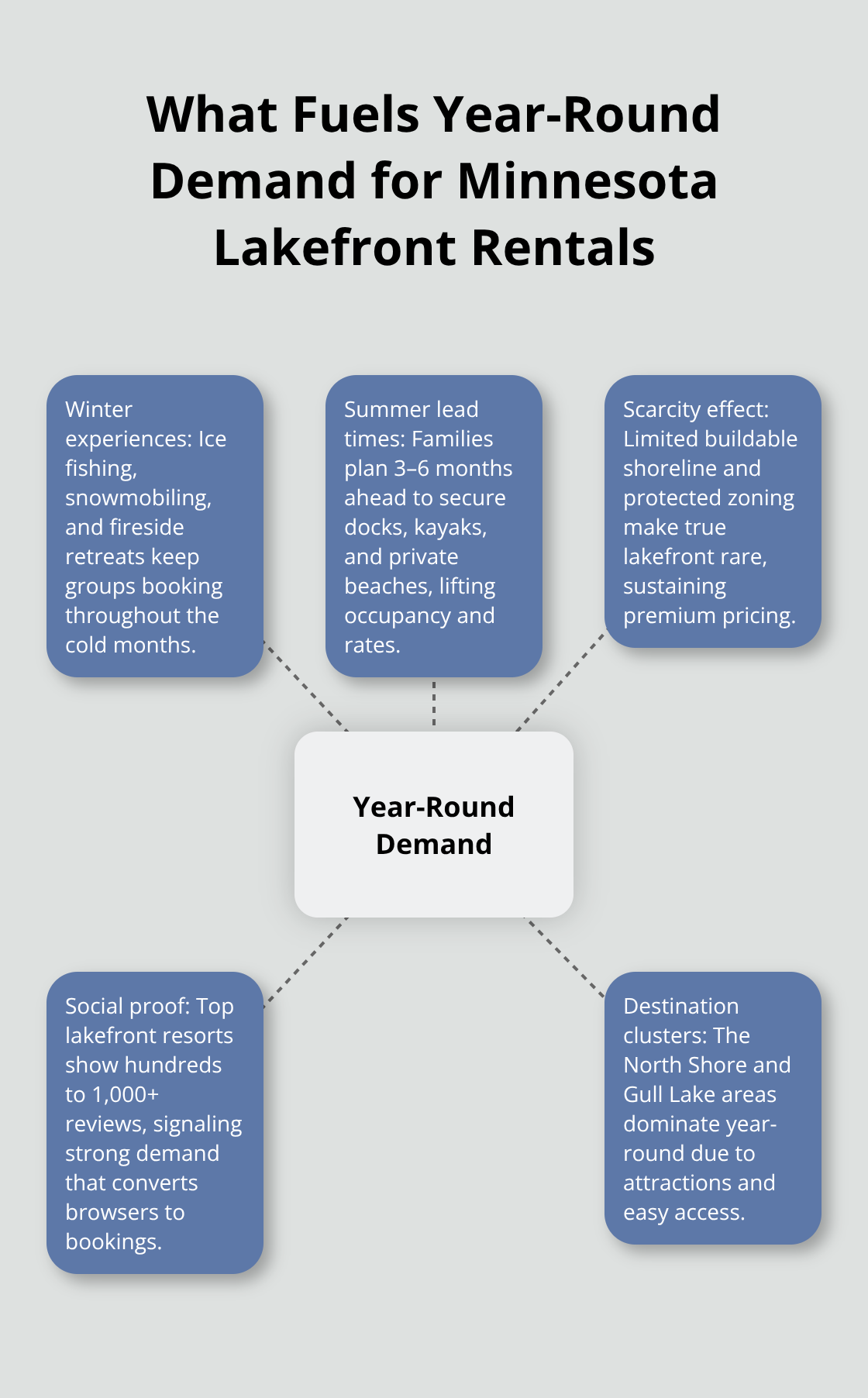
Minnesota’s lakefront rental market operates in a seller’s favor. Beacon Pointe on Lake Superior charges starting rates around $111 per night with a 4.5/5 rating from 1,196 reviews, while South Pier Inn in Duluth commands $151 nightly with a 4.8/5 from 1,299 reviews. These properties aren’t exceptions-they’re the standard. Waterfront homes consistently fetch 40-60% higher nightly rates than comparable non-waterfront properties in the same regions. This premium exists because Minnesota’s 10,000 lakes create a perception of scarcity that’s actually grounded in reality. TripAdvisor’s top 10 Minnesota lakefront resorts show properties with hundreds to over 1,000 reviews each, indicating sustained booking demand. The North Shore corridor near Lake Superior and the Gull Lake cluster near Brainerd dominate bookings year-round.
Winter doesn’t slow demand-it shifts it. Ice fishing, snowmobiling, and fireside retreats attract families and groups during months when landlocked properties sit empty. Summer demand remains ferocious because families book 3-6 months ahead for peak season access to docks, kayaks, and private beaches.
Limited Buildable Shoreline Creates Real Scarcity
Minnesota’s lakes have finite waterfront, and zoning restrictions protect environmental standards. New lakefront construction faces regulatory scrutiny that drives costs up and availability down. Existing waterfront rentals rarely leave the market-owners recognize their assets appreciate faster than inland properties. This scarcity justifies premium pricing because guests have fewer alternatives.
When a property offers direct water access with a private dock and fire pit, competing properties without those features simply aren’t substitutes. Guests searching for lakefront experiences on Airbnb find properties like Agua Norte Cabin, which Condé Nast recognized as Minnesota’s Coolest Airbnb and featured on HBO’s Cabin Chronicles. That level of distinction commands $300+ nightly rates.
Premium Amenities Drive Price Insensitivity
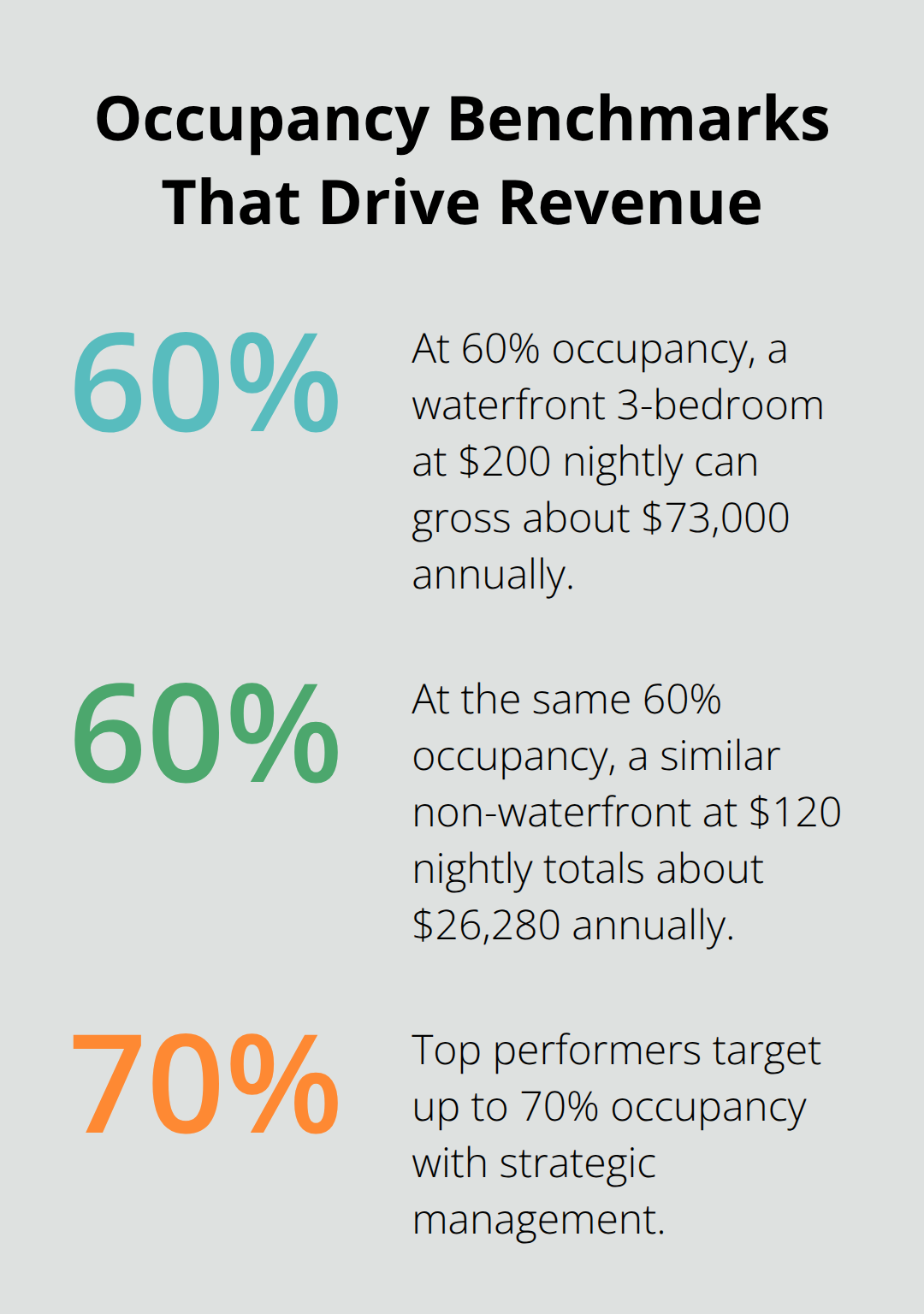
Properties with saunas, hot tubs, and expansive lake-view decks occupy a market segment where price sensitivity disappears. Families and groups willing to spend $150-250 per night prioritize water access and premium amenities over savings. The math is clear: a 3-bedroom waterfront cabin with hot tub and dock at $200 nightly generates $73,000 annually at 60% occupancy. The same cabin without waterfront access rents at $120 nightly and generates $26,280 annually at 60% occupancy.
Hot tubs, saunas, and outdoor fire pits appear across nearly every high-rated Minnesota lakefront listing. These aren’t luxury extras-they’re baseline expectations. Properties missing them receive lower rates and slower booking velocity. Water-specific amenities matter even more. Private docks, included kayaks, and boat access transform a rental from nice to essential for guests planning water activities.
Layered Amenities Sustain Occupancy Year-Round
Larsmont Cottages on Lake Superior earns 4.5/5 from 912 reviews partly because it delivers direct shoreline access with cozy fireplaces. Indoor amenities that support longer stays-full kitchens, game rooms, fast Wi-Fi-keep occupancy high during off-peak seasons. Properties marketed as work-from-home capable attract remote workers who extend stays into shoulder seasons.
Grand View Lodge near Brainerd on Gull Lake maintains a 4.4/5 rating from 1,238 reviews because it combines waterfront access with multiple pools and family-friendly activities. These layered amenities justify $120+ nightly rates consistently. Outdoor living spaces-expansive decks, gazebos, and lakeside seating-directly correlate with booking rates. Guests pay premium prices for properties where interior and exterior blend seamlessly.
Year-Round Positioning Maximizes Annual Revenue
The seasonal reality matters significantly. Properties that offer year-round appeal command higher overall revenue because winter bookings at $100-130 nightly offset summer price increases. A property positioned for ice fishing and snowmobiling in winter, then boating and swimming in summer, achieves higher annual occupancy than seasonal-only alternatives. This dual-season strategy transforms what could be a 6-month operation into a 12-month revenue generator.
Owners who master this positioning attract different guest profiles across seasons. Summer families book months ahead, while winter enthusiasts often plan trips with shorter lead times. Properties that cater to both markets capture revenue streams that single-season rentals miss entirely. The next section shows how strategic pricing and marketing amplify these advantages even further.
Pricing, Photography, and Marketing That Drive Bookings
Dynamic Pricing Captures Seasonal Demand Spikes
Maximizing occupancy requires three interconnected systems working simultaneously. Pricing must respond to demand signals in real time rather than staying fixed year-round. Properties near Gull Lake and Lake Superior experience demand spikes around holidays, summer weekends, and winter ice-fishing season. A cabin renting at $120 nightly in March should command $180–200 during peak summer weeks and $140–160 during winter holidays. Professionals adjust rates weekly based on local events, weather patterns, and competing listings. When Duluth hosts the Grandma’s Marathon in June or when winter snowmobiling conditions peak in January, dynamic pricing boosts vacation rental revenue by 10-40% annually through real-time rate adjustments.
Conversely, shoulder seasons in April and October justify rate reductions of 15–20% to fill gaps. Most owners treat pricing as static and leave thousands on the table annually. Owners who manually adjust rates weekly capture an additional $8,000–15,000 annually on a three-bedroom property compared to those using flat rates. Properties with fast internet and dedicated workspaces command $20–40 premium nightly rates during spring and fall when remote workers plan extended stays.
Professional Photography Drives Inquiry Rates
Professional photography and virtual tours function as your highest-ROI marketing investment. Properties featuring high-quality photography showing lake views, hot tubs, and outdoor spaces from multiple angles receive booking increases of 20-40% compared to smartphone photos. Agua Norte Cabin’s recognition as Minnesota’s Coolest Airbnb by Condé Nast and its HBO feature didn’t happen by accident-the property’s visual presentation set it apart immediately. Potential guests form booking decisions within seconds of viewing listing photos, making image quality non-negotiable.
Targeted Marketing Reaches the Right Guests
Targeted marketing to specific demographics amplifies booking velocity substantially. Families with children aged 5–12 searching for summer vacations book 3–6 months ahead and prioritize properties with game rooms, multiple bedrooms, and safe water access. Marketing to this segment means emphasizing family amenities on platforms where parents actively search. Couples seeking romantic getaways year-round respond to sauna and hot tub imagery, privacy descriptions, and proximity to fine dining in nearby towns.
Properties near the North Shore near Grand Marais, Lutsen, and Duluth should highlight access to Gooseberry Falls and Split Rock Lighthouse in marketing copy. Properties near Brainerd should emphasize the Paul Bunyan Trail and golf courses. Marketing segments matter because a couple booking for a winter weekend has different priorities than a family planning a two-week summer stay.
Guest Reviews Convert Lookers Into Bookers
Waterfront rentals with strong guest reviews-averaging 4.5 or higher from hundreds of reviews-convert lookers into bookers at rates 2–3 times higher than properties with fewer reviews or lower ratings. This means maintaining cleanliness and guest communication standards isn’t optional. Consistency in guest experience directly translates to occupancy rates and nightly revenue. Properties that respond quickly to guest inquiries and deliver spotless accommodations build review momentum that compounds over time. The next section addresses the mistakes that undermine these systems and how to avoid them.
Common Mistakes Lakefront Rental Owners Make
The gap between what lakefront properties should earn and what they actually earn comes down to three concrete mistakes that compound over time. Owners leave $15,000–30,000 annually on the table because they price reactively instead of strategically, skip maintenance until guests complain, and fail to communicate what their property actually offers. These aren’t minor inefficiencies-they’re revenue killers that destroy occupancy rates and guest satisfaction simultaneously.
Underpricing Destroys Long-Term Revenue
Underpricing happens because owners anchor to their first season or match a competitor’s listing without understanding the market dynamics underneath. A three-bedroom waterfront cabin with a hot tub and dock should start at $160–180 nightly in shoulder seasons and jump to $220–260 during peak summer and winter holidays. Instead, owners often lock in $140 year-round because they fear losing bookings or don’t track what comparable properties charge. This single mistake costs approximately $12,000–18,000 annually on a property that achieves 60% occupancy.
The owner rationalizes the lower rate by thinking it guarantees full occupancy, but waterfront properties with premium amenities don’t lose bookings when priced correctly-they lose them when priced too low because potential guests assume something is wrong. Guests searching for luxury lakefront experiences expect to pay $150+, and properties undercutting that threshold actually reduce inquiry volume because the listing appears questionable. Waterfront properties with strong amenities attract guests willing to pay premium rates; owners who discount aggressively signal weakness rather than value.
Maintenance Gaps Create Cascading Damage
Maintenance gaps create the second revenue drain, and this one damages both current and future earnings. Properties that skip seasonal upkeep-winterizing hot tubs incorrectly, neglecting dock maintenance, ignoring roof inspections-face expensive emergency repairs that force cancellations mid-season. A dock that collapses or hot tub that fails during peak summer costs $8,000–15,000 to repair and wipes out multiple bookings.
More insidious is the slow decay that accumulates when owners treat maintenance as optional. Grout deteriorates, deck stain fades, appliances age without servicing, and within two years the property that rented for $180 nightly now commands $130 because reviews mention worn finishes and slow Wi-Fi. Properties maintained consistently-deck staining every 3–4 years, annual HVAC service, quarterly dock inspections-hold premium rates indefinitely and generate $10,000–15,000 more annually than properties that deteriorate.
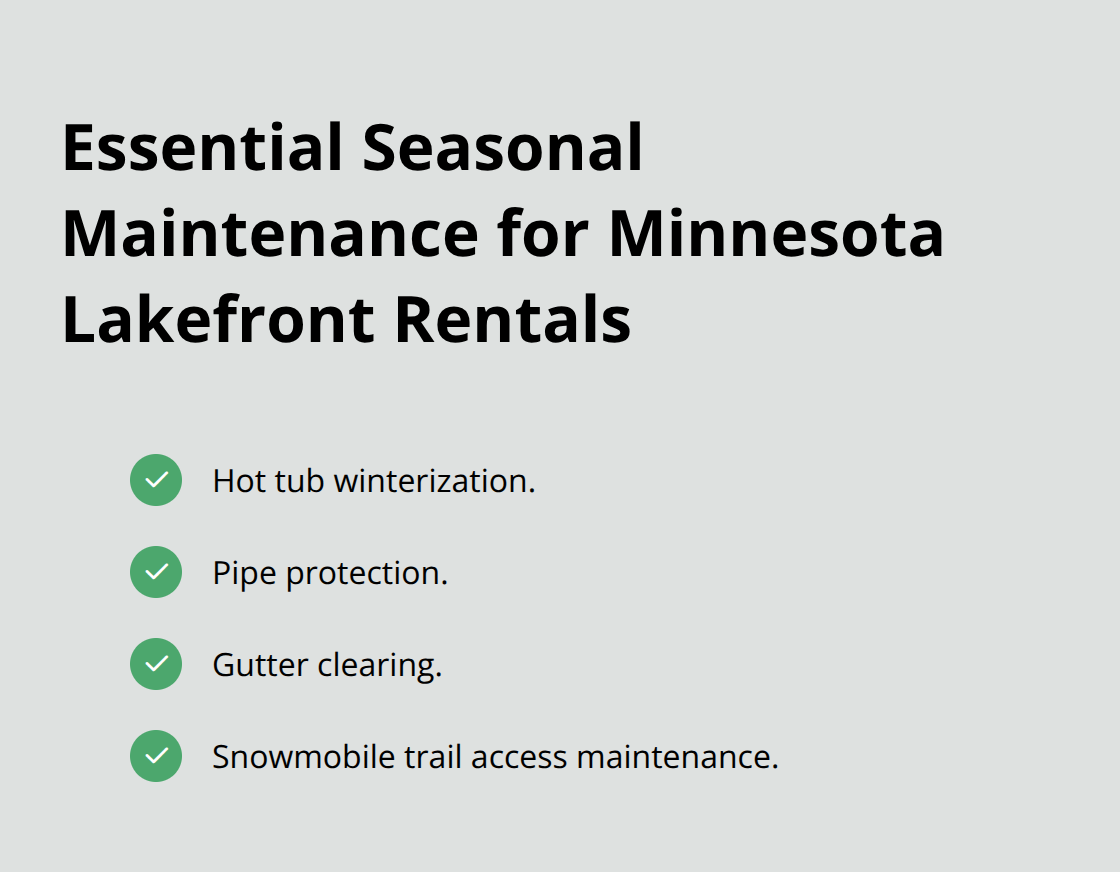
Seasonal preparation matters especially in Minnesota because winter demands specific attention: seasonal maintenance for Minnesota lakefront properties includes hot tub winterization, pipe protection, gutter clearing, and snowmobile trail access maintenance. Owners who neglect these tasks lose the winter revenue stream entirely and face costly spring repairs that delay summer bookings.
Communication Failures Destroy Guest Trust
Communication failures about amenities create friction that destroys reviews and repeat bookings. Owners often fail to explain what amenities guests receive or how to use them, leaving guests frustrated during their stay. A property with a sauna should include detailed instructions about temperature settings, duration recommendations, and safety protocols in the welcome packet. Properties with docks should specify water depth, boat launch procedures, and seasonal availability dates clearly in the listing and confirmation emails.
Guests who arrive expecting a functioning dock but find it out of the water post-October 15 feel deceived, regardless of what the listing technically stated. This generates one-star reviews that tank future bookings. Clear communication about what’s included-kayaks, fire pit wood, beach towels, Wi-Fi password-prevents the small frustrations that accumulate into poor reviews.
Properties that proactively message guests about local attractions, restaurant recommendations, and activity options receive consistently higher ratings because guests feel informed and supported. The difference between a 4.3-star property and a 4.8-star property often comes down to communication consistency, not amenity quality. Owners who treat guest communication as a core responsibility rather than an afterthought build the review momentum that drives future bookings and justifies premium rates.
Final Thoughts
Minnesota lakefront vacation rentals succeed when owners execute three core strategies consistently: price dynamically based on seasonal demand and local events, invest in professional photography and targeted marketing that reaches families and couples, and maintain properties obsessively while communicating clearly with guests about what they receive. A three-bedroom waterfront cabin managed strategically generates $60,000–90,000 annually at 60–70% occupancy, while the same property managed poorly generates $30,000–40,000 annually because of underpricing, maintenance gaps, and weak guest communication. That $30,000–50,000 annual difference compounds over years into hundreds of thousands in lost wealth.
Professional management eliminates the operational burden that causes most owners to make these mistakes. We at Up North Property Management handle the systems that drive results: dynamic pricing that captures seasonal demand, professional marketing to targeted demographics, consistent maintenance that preserves property value, and guest communication that builds review momentum. Our full-service approach means owners receive hassle-free income while properties operate at peak efficiency year-round.
If you manage a property yourself and see occupancy below 65% or nightly rates below market comparables, the gap likely stems from pricing, marketing, or communication failures. If maintenance feels overwhelming or seasonal preparation creates stress, professional management eliminates that friction entirely. Contact Up North Property Management to discuss how full-service management transforms Minnesota lakefront vacation rentals into reliable income streams that require minimal owner involvement.