

Cabin owners often leave money on the table by pricing the same way year-round. The difference between a booked cabin and an empty one often comes down to your pricing strategy.
At Up North Property Management, we’ve seen how the right approach to cabins occupancy profits transforms seasonal properties. This guide walks you through proven methods to maximize revenue without sacrificing bookings.
When Should You Raise Your Cabin Rates
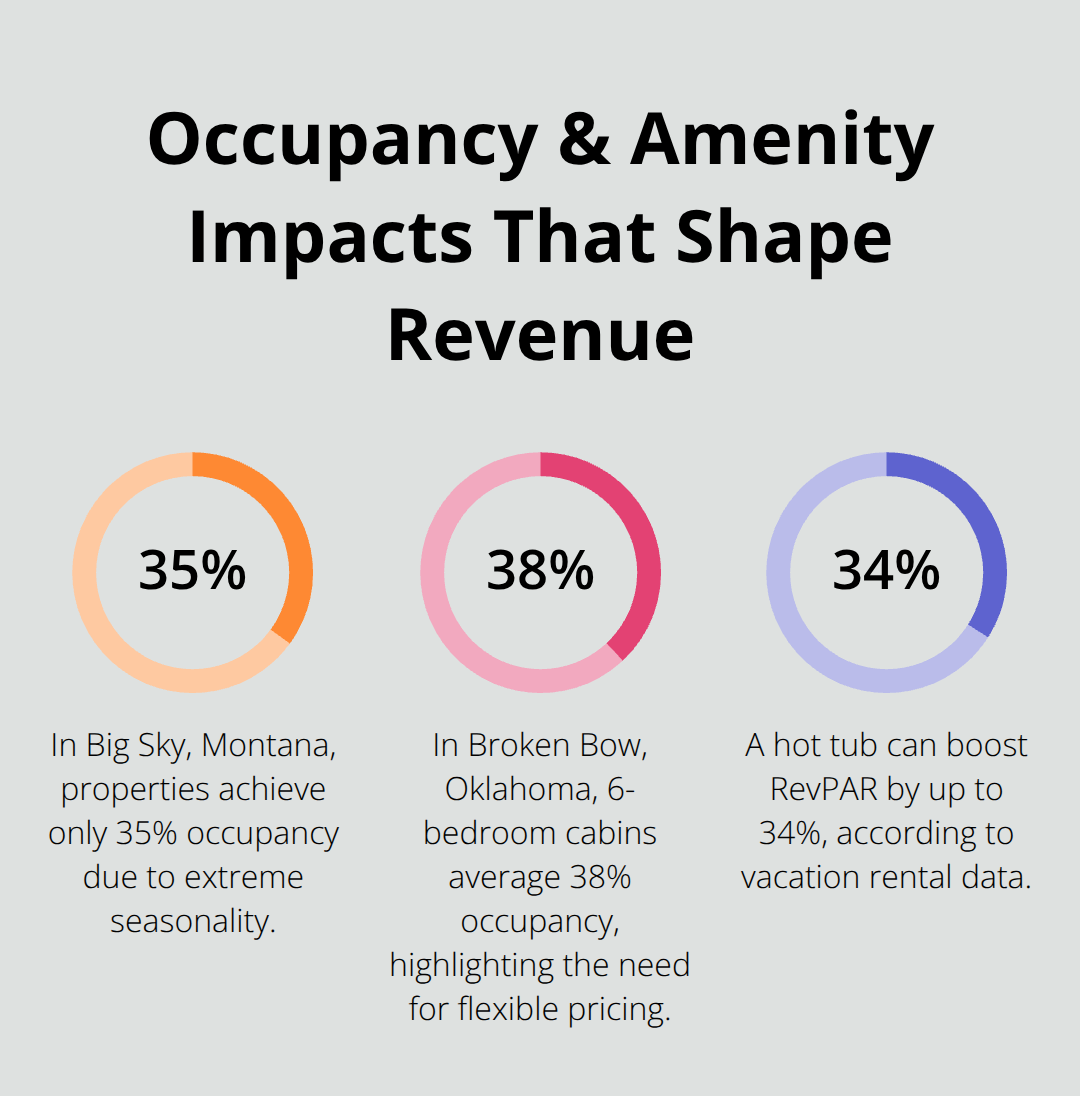
Seasonal demand creates predictable revenue windows that most cabin owners fail to exploit. Summer peaks and winter holidays generate obvious spikes, but the real profit comes from understanding the intensity and timing of these cycles in your specific market. In Gatlinburg, for example, a 6-bedroom cabin generates $138,630 annually compared to just $36,187 for a 2-bedroom-a 3.8x gap driven primarily by higher nightly rates during peak periods rather than occupancy differences. This tells us that pricing strategy matters far more than bed count alone. Your rates should climb aggressively during summer weeks, major holidays, and local festival periods when demand outpaces supply. In Big Sky, Montana, properties command an average daily rate of $818 but achieve only 35% occupancy due to extreme seasonality-a clear signal that owners prioritize high nightly rates over filling empty nights. That approach works only if you accept significant downtime.
Finding Revenue in the Quiet Months
Off-season pricing requires a fundamentally different mindset than peak pricing. Rather than maintaining high nightly rates, you shift your goal to filling nights that would otherwise sit empty. Markets like Shenandoah, Virginia and Hocking Hills, Ohio show strong revenue potential at $57,196 and $55,615 annually despite undersupply, which means consistent occupancy across multiple seasons matters more than chasing peak premiums. Shoulder seasons and mid-week periods typically see rates 15–20% lower than peak times, but those discounts drive bookings that generate revenue at better margins than vacancy. You should offer weekly discounts outside peak periods to attract remote workers and longer-stay guests who support your cash flow during slower months. Broken Bow, Oklahoma demonstrates this dynamic clearly-6-bedroom cabins reach $131,810 annually, but booking lead times stretch to 47 days with only 38% occupancy, making flexible pricing and lead-time strategy critical to success.
Timing Your Price Changes Around Local Events
Event-driven pricing adjusts vacation rental rates in response to local events and festivals that create temporary demand spikes. A music festival, conference, or sporting event can push rates up overnight in nearby areas, and visitor bureaus typically publish these calendars months in advance. You should identify these events early and adjust your pricing 60–90 days before they occur, rather than waiting for demand to appear. This approach prevents you from selling nights at standard rates that could command premium prices. You need to track not just major holidays but regional attractions-concerts, conventions, wedding seasons-that draw visitors to your area. Competitive pricing analysis reveals what similar properties charge during these windows, and market-specific data on how rates shift around known events becomes your competitive advantage.
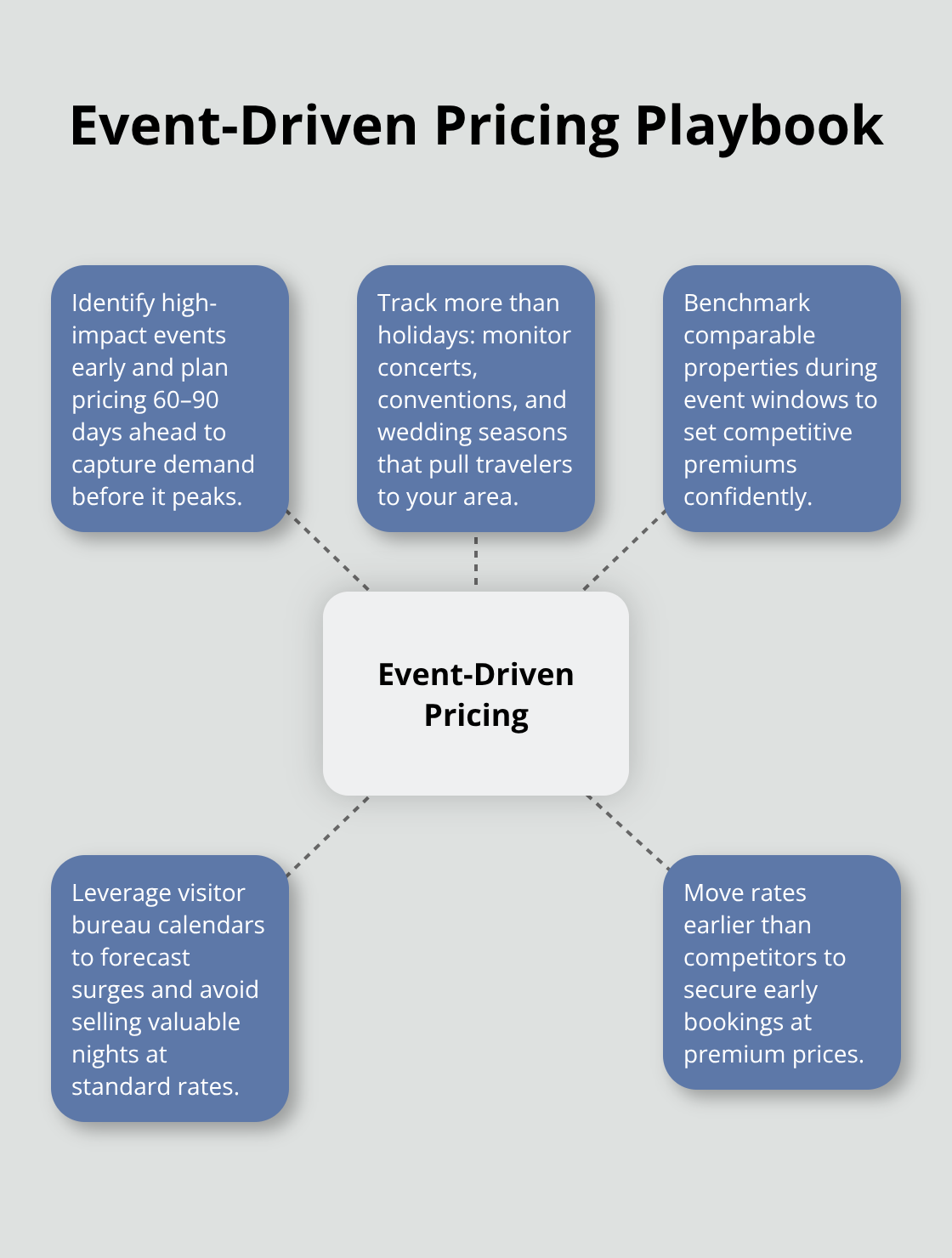
You move faster than competitors when you spot these opportunities and adjust your rates accordingly.
How to Adjust Rates Without Losing Bookings
The gap between your best month and worst month reveals whether you price strategically or leave money behind. Cabin owners who treat pricing as static miss the reality that demand shifts weekly, sometimes daily, based on booking patterns and competitive moves. When you watch your calendar, you notice that bookings cluster around certain dates-Friday and Saturday check-ins command higher rates than mid-week arrivals, sometimes 20–30% more depending on your market. This isn’t coincidence. Raise rates on weekends and lower them on Tuesdays and Wednesdays to fill nights that would otherwise sit empty. A 4-bedroom cabin with 50% weekend occupancy and 25% mid-week occupancy loses significant revenue compared to one achieving 60% occupancy across all days through strategic pricing. The math is straightforward: a $200 nightly rate on a Tuesday with a booking beats a $300 rate with no guest. Longer stays also deserve different pricing. Properties that offer weekly rates 10–15% below the nightly rate attract remote workers and multi-week guests who provide stable cash flow and reduce turnover costs. In Broken Bow, Oklahoma, where 6-bedroom cabins average 38% occupancy with 47-day booking lead times, owners who offer discounted weekly rates fill gaps that would otherwise generate zero revenue. Price based on what your calendar shows, not what you hope guests will pay.
Respond Quickly When Competitors Drop Their Rates
Competitive pricing analysis isn’t about matching every competitor dollar-for-dollar. It’s about understanding your market position and defending it when supply increases or demand shifts. If three similar cabins in your area suddenly drop rates by 15%, ignoring that move costs you bookings within days. Check competitor rates weekly during peak season and bi-weekly during slower periods. Tools like AirDNA provide market-specific data on average daily rates and occupancy across your region, allowing you to benchmark against properties with similar bed counts and amenities. A cabin undershooting the market average by 30% attracts bargain hunters who leave poor reviews, while overshooting by 25% sits empty for weeks. The sweet spot is within 10–15% of comparable properties, adjusted for your unique features-a hot tub adds 20–25% to nightly rates and boosts RevPAR by up to 34%, according to vacation rental data. Competitive pricing also means monitoring when competitors raise rates around local events. If a festival weekend approaches and three cabins increase rates to $350 while you remain at $280, you’ve already lost those bookings. Move your rates up simultaneously with competitors or slightly ahead to capture early bookings at premium rates.
Automation Removes Guesswork From Rate Changes
Manual pricing wastes time and leaves money on the table because you can’t track every market variable simultaneously. Dynamic pricing tools analyze thousands of data points-local events, airline patterns, competitor availability, day of week, booking lead time, and seasonality-to adjust your rates automatically. AvantStay uses an AI-driven pricing engine across 2,300-plus properties, creating 75–150 micro-seasons per home with daily adjustments that capture demand spikes you’d miss manually. These tools integrate directly with your booking platforms, so rates update across Airbnb, Vrbo, and Booking.com simultaneously without double-bookings or manual uploads. The payoff is measurable: properties using automated pricing typically see 8–12% revenue increases within the first three months because rates adjust in real-time rather than staying static for weeks. Set price floors and ceilings to protect your margins and brand positioning, then let the algorithm handle daily moves. This approach works especially well in markets with unpredictable demand or those where local events shift frequently. You avoid the common mistake of raising rates too late or dropping them too early, both of which cost revenue. The next critical step involves understanding which operating costs you’ve overlooked in your pricing calculations-a gap that separates profitable cabin owners from those who watch their margins erode.
Common Pricing Mistakes That Reduce Profits
Cabin owners sabotage their own revenue through three avoidable mistakes that compound over time. The first is underpricing during peak demand windows when guests will pay significantly more. You see this constantly in markets like Gatlinburg, where the revenue gap between a 2-bedroom and 6-bedroom cabin reaches 3.8x, yet many owners price their properties as though demand is flat year-round. When summer arrives and your calendar fills with booking requests, raising rates by 40-50% above your baseline is not aggressive-it’s standard market practice. Guests booking peak season expect to pay premium prices, and they’ll find similar cabins at those rates within minutes. The second mistake is ignoring competitor rate changes until bookings dry up. If three comparable properties in your market drop rates by 15% on a Monday, your calendar will show cancellations and declined inquiries by Wednesday. Weekly rate monitoring during peak season and bi-weekly checks during slower periods aren’t optional-they’re baseline operational discipline. AirDNA provides market-specific occupancy and ADR data that shows you exactly where your pricing stands relative to similar properties. A cabin undershooting the market average by 30% attracts low-quality guests who leave poor reviews, while overshooting by 25% sits vacant for extended periods. The third and costliest mistake is failing to account for operating costs when setting rates. Many cabin owners calculate their nightly rate by dividing annual mortgage or loan payments by expected nights, then adding a small margin. This ignores cleaning costs between guests, emergency repairs, landscaping, property taxes, insurance, platform commissions, and seasonal maintenance. In Broken Bow, Oklahoma, where 6-bedroom cabins average only 38% occupancy despite reaching $131,810 annually, owners who didn’t factor turnover costs into their pricing likely underestimated how many nights they actually needed to book. A $200 nightly rate that sounds profitable becomes unprofitable when you subtract $60 in cleaning, $15 in platform fees, $20 in property maintenance allocation, and $25 in unexpected repairs. You need a rate that covers all these expenses plus generates actual profit margin. Calculate your true all-in cost per night, then price 25-35% above that floor to account for vacancy and profit.
Underpricing During High Demand
Setting rates without understanding your cost structure is financial guesswork. Most cabin owners know their mortgage or loan payment and estimate guest nights, then divide one by the other to establish a baseline rate. This approach misses the operational reality. Cleaning typically costs $150-300 per turnover depending on cabin size and standards, and you clean between every guest-not monthly or seasonally. Platform commissions range from 5-14% depending on whether you use Airbnb, Vrbo, or Booking.com, meaning a $250 nightly rate loses $12.50-35 to fees before it reaches your account. Property maintenance allocation should be 5-10% of gross revenue based on industry standards, emergency repairs happen unpredictably, and seasonal expenses like winterization or deck staining don’t fit neatly into monthly budgets. When you account for these expenses honestly, your required nightly rate climbs significantly. A cabin generating $50,000 in gross revenue needs $2,500-5,000 allocated to maintenance alone. If you price to hit $50,000 gross but haven’t reserved that cushion, you operate at negative margins once repairs occur. The solution is building a detailed operating cost spreadsheet that includes every expense category, then dividing annual costs by realistic occupancy rates to establish your true required nightly rate. Price 30% above that number, not 10%. This protects you against occupancy shortfalls and unexpected expenses while generating genuine profit.
Ignoring Competitor Rate Changes
Waiting to respond to competitor rate changes costs bookings within 48-72 hours because guests shop actively during peak season. When three similar cabins in your market drop rates by $40-60 per night, your booking inquiry rate drops simultaneously. You notice the change when bookings don’t materialize, meaning you’ve already lost 2-3 days of potential revenue. The operational fix is setting a weekly rate review calendar during peak season and bi-weekly during off-peak periods, with alerts configured to notify you when competitor rates change beyond your threshold. If you manage multiple properties, this becomes impossible without tools. Dynamic pricing software monitors competitors automatically and adjusts your rates in real-time, but even basic spreadsheet tracking beats ignoring the market entirely. During peak season when rates shift frequently, monthly pricing reviews move too slowly. You compete against properties that adjust rates daily based on booking patterns and local demand. The cabin owner who checks rates weekly and adjusts within 24 hours captures bookings that go to competitors who check monthly. This isn’t theoretical-it’s the difference between 55% occupancy and 65% occupancy in the same market with similar properties.
Failing to Account for Operating Costs
Owners who skip cost calculations drift toward breakeven or losses while believing they run a profitable operation. Your rates must cover all expenses plus generate actual profit margin. Calculate your true all-in cost per night (mortgage, cleaning, maintenance, insurance, platform fees, property taxes, and seasonal repairs), then price 25-35% above that floor to account for vacancy and profit. Many cabin owners underestimate how many nights they actually need to book to cover expenses. In markets with lower occupancy rates (like Broken Bow at 38%), this miscalculation becomes especially costly. A $200 nightly rate sounds profitable until you subtract $60 in cleaning, $15 in platform fees, $20 in property maintenance allocation, and $25 in unexpected repairs. You’re left with $80 per night before mortgage, taxes, and insurance. That margin disappears quickly when occupancy drops or emergency repairs occur. Build a spreadsheet that tracks every expense category, allocate costs across realistic occupancy projections, and price accordingly. This protects you against occupancy shortfalls and unexpected expenses while generating genuine profit rather than operating on hope.
Final Thoughts
Your cabin’s occupancy profits depend on executing three fundamentals consistently. Calculate your all-in cost per night by accounting for cleaning, platform commissions, maintenance allocation, property taxes, insurance, and seasonal repairs, then price 25-35% above that floor to generate genuine profit. Commit to weekly rate reviews during peak season and bi-weekly during slower periods, since competitor rate changes ripple through your bookings within 48-72 hours and waiting costs revenue.
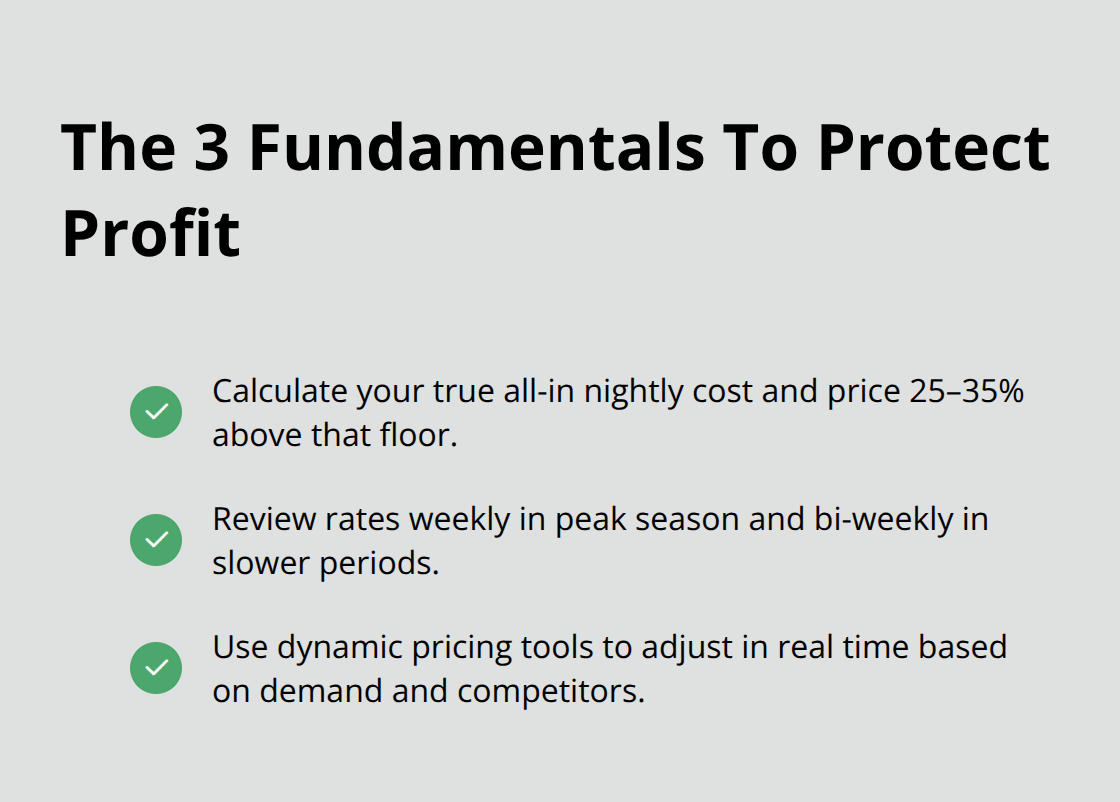
Implement dynamic pricing tools that adjust rates automatically based on booking patterns, local events, and competitor moves, because manual pricing cannot compete with properties using automation in markets where demand shifts frequently.
Markets like Gatlinburg and Broken Bow demonstrate that pricing strategy matters more than property size or location alone. The 6-bedroom cabin generating 3.8x more revenue than a 2-bedroom achieves this result through strategic pricing that captures peak demand while filling off-season nights through discounts. Your rates must reflect both what the market will pay and what your property actually costs to operate, separating profitable cabin owners from those who watch margins erode despite full calendars.
If managing pricing, bookings, and operations feels overwhelming, Up North Property Management handles the complete process for Northern Minnesota properties. They manage marketing, bookings, cleaning, and maintenance while implementing aggressive pricing strategies that maximize your cabins occupancy profits. Letting professionals handle these details frees you to focus on ownership while your property generates consistent income year-round.