

Cabin pricing isn’t one-size-fits-all. The owners who earn the most revenue adjust their rates based on demand, seasonality, and what competitors charge.
We at Up North Property Management have seen firsthand how the right pricing strategy can increase annual revenue by thousands of dollars. This guide walks you through proven tactics and tools to optimize your cabin’s earning potential. Up North Property Management uses dynamic cabin pricing strategies with daily rates being updated every 24 hours based on real reservation data from Airbnb and Vrbo.
Understanding Market Demand and Seasonality
Successful cabin pricing starts with understanding what drives bookings in your market. The Smoky Mountains alone have roughly 16,000 cabins competing for the same guests, which means pricing without data is essentially guessing. You need to know when demand peaks, what local events pull visitors, and how your competitors are pricing their properties. Understanding market demand and seasonality shapes vacation rental pricing through factors including seasonality, local events, lead time, day of the week, length of stay, and your competitive set.
Start by pulling your booking data from the last two years and marking which weeks filled fastest and which sat empty. Peak seasons typically command premium rates 20-40% above your baseline price, while shoulder seasons run 10-15% below peak with weekly discounts to attract longer stays. Off-peak periods need 15-25% discounts plus monthly incentives to move inventory.
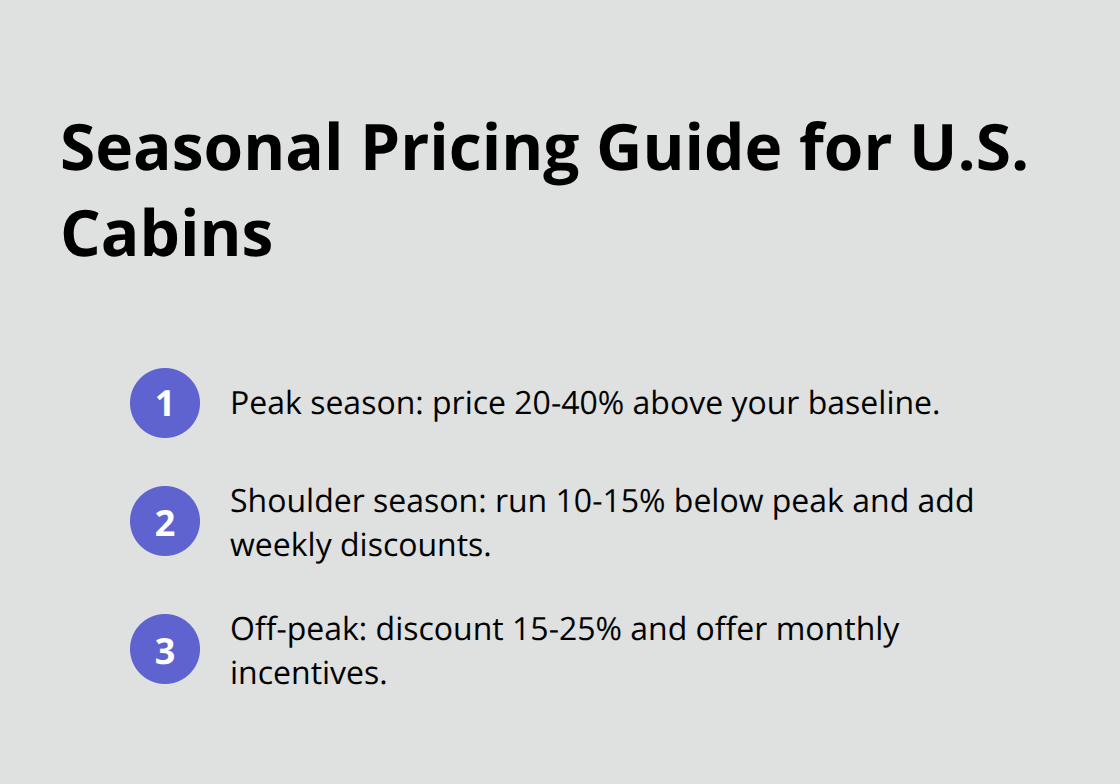
The difference between peak and off-season isn’t subtle-it’s the difference between 90-95% occupancy with ADR up 50-200% versus baseline rates, versus 50-70% occupancy during shoulder weeks.
Local Events Drive Urgent Demand
Local events create sudden spikes in willingness to pay. Festivals, conventions, university move-ins, and sports tournaments pull visitors who book quickly and pay premium rates. When an event week arrives, occupancy can hit 90-95% with guests willing to pay significantly more. Most owners react too late to these opportunities.
Plan rate increases well in advance of known events, shorten minimum stay requirements to capture more bookings, and use your competitor set to guide how high you can go. Weather also matters-ski season, summer vacation windows, and holiday breaks are predictable demand drivers. Track these on your calendar monthly so you’re not scrambling when March rolls around.
Monitor your 60-90 day pipeline regularly to spot booking velocity. If bookings accelerate toward a date, raise rates immediately. If pacing lags market benchmarks, deploy discounts or promotions to avoid empty nights.
Competitor Pricing Shapes Your Baseline
Your comp set should include 10-15 cabins similar to yours by location, size, amenities, and occupancy performance. Check their pricing every week, especially within the 14-30 day window when most bookings happen. Professional pricing tools like PriceLabs, Beyond Pricing, and Wheelhouse automate this monitoring and suggest rate adjustments based on real-time market data. These tools typically cost between 1% of gross bookings or $10-20 monthly, and they reduce the pricing burden by 70-80%.
If your cabin is new or has fewer reviews, price slightly below comps initially to gain traction and reviews, then adjust upward as credibility builds. If you’re outperforming comps in occupancy, you’re likely underpriced-raise your baseline by 5-10%. If you’re significantly underperforming, occupancy or listing quality may be the issue, not price.
Track your occupancy percentage, average daily rate, and revenue per available night weekly to catch pricing misalignment before it costs you thousands. These metrics reveal whether your rates align with market demand and guest willingness to pay.
Pricing That Matches What Guests Will Actually Pay
Dynamic pricing works because it aligns your rates with real demand rather than guessing what guests will pay. Dynamic pricing delivers a 36% revenue increase compared to static pricing by adjusting nightly rates based on occupancy, local events, and booking patterns.
Tiered Pricing Captures Demand Swings
Tiered pricing means establishing a baseline rate, then adding premiums for high-demand dates and applying discounts for slow periods. If your baseline is $150 per night, your peak weekend might be $210 (40% premium), a shoulder-season weekday might be $128 (15% discount), and an off-peak Monday could be $120 (20% discount). Set these tiers before the season starts, not after bookings arrive. Use your comp set data to validate whether your tier structure makes sense-if competitors run 20-40% premiums during peak weeks, you should too.
Length-of-Stay Discounts Reduce Turnover Costs
Length-of-stay discounts work because they reduce your cleaning and turnover costs. A 7-night stay costs roughly half as much to manage as seven separate 1-night bookings. Offer 15% off weekly rates for 7-9 nights and 20-30% off monthly rates for 28+ nights. This strategy attracts digital nomads and families planning longer trips while protecting your bottom line.
Extended stays of 60-90 nights boost gross profit by 10-15% due to lower turnover costs and reduced guest management overhead. The math is straightforward: if cleaning costs $80 and a 1-night booking generates $150, your profit is $70. A 7-night stay at $127 per night (15% discount) generates $889 with one cleaning cost, yielding $809 in profit-that’s $115 per night.
Minimum Stay Rules Protect Revenue During Slow Periods
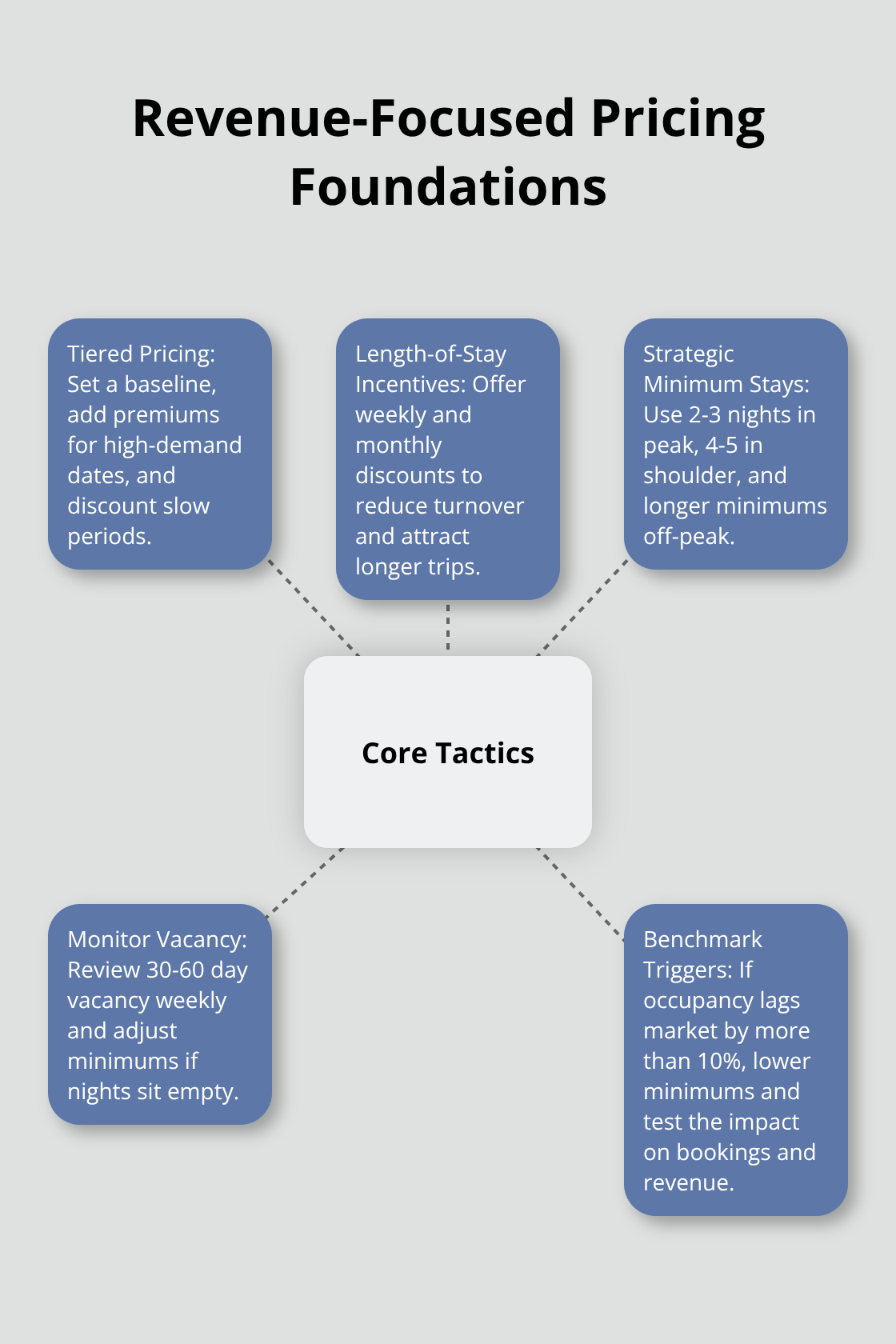
Minimum stay requirements during slow seasons protect against low-revenue bookings that waste your operational capacity. During peak season, a 2-3 night minimum maximizes bookings since demand is high. During shoulder season, extend your minimum to 4-5 nights to filter out short stays that generate minimal revenue after cleaning and turnover. In off-peak months, consider a 7-night minimum or offer weekly discounts to attract longer commitments.
Monitor your 30-60 day vacancy rate weekly and adjust minimums if you sit empty. If your occupancy lags market benchmarks by more than 10%, lower your minimum stay requirement by one night and test the impact on bookings and revenue. These three tactics-tiered pricing, length-of-stay incentives, and strategic minimums-form the foundation of revenue-focused pricing, but they only work when you implement them with the right tools and track their performance consistently.
Tools and Technology for Dynamic Pricing
The cabin owners earning the most revenue don’t manually adjust rates every day. They use pricing software to monitor demand, competitor rates, and booking velocity automatically, then apply those insights across hundreds of rate changes. A 2025 Your.Rentals study across 541 listings found dynamic pricing yields a 36% revenue increase compared to static pricing. That’s not theoretical. That’s measurable, consistent revenue growth across real properties.
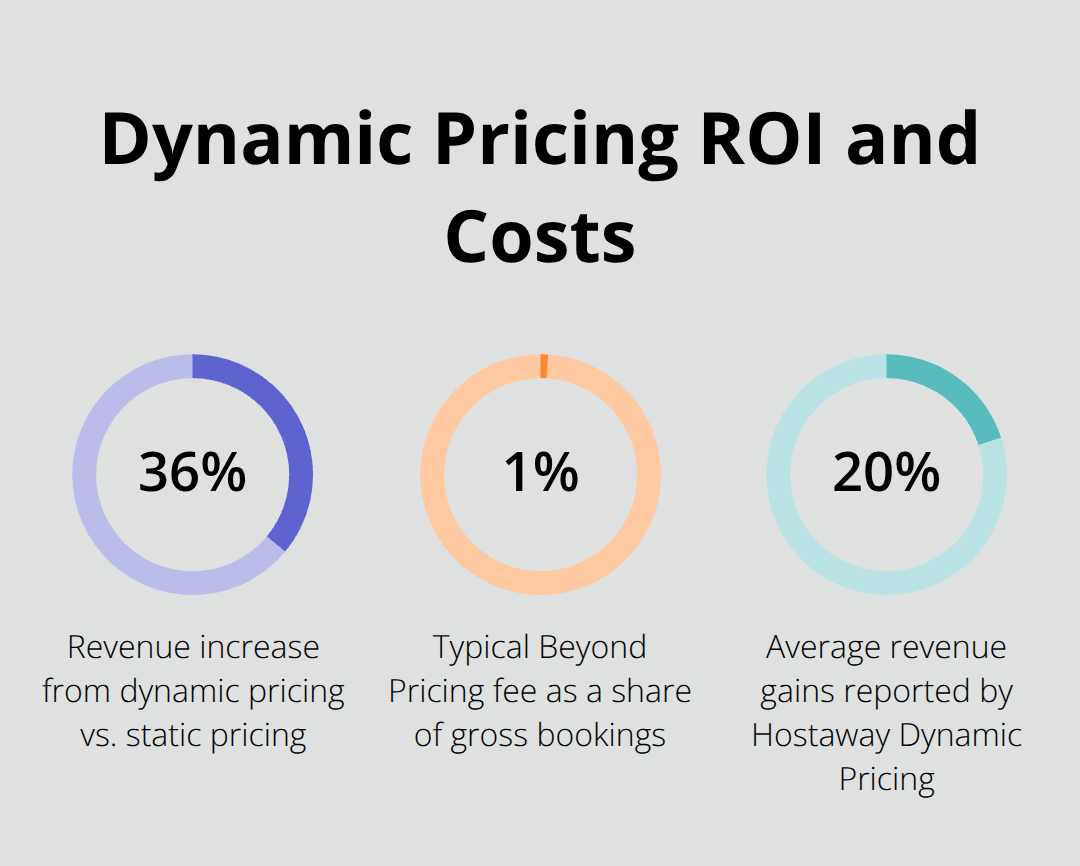
PriceLabs and Beyond Pricing stand out because they reduce the pricing burden by 70-80% while delivering aggressive rate suggestions your platform’s built-in pricing engine won’t touch. Beyond Pricing typically costs about 1% of gross bookings, while PriceLabs runs $10-20 monthly depending on features. Wheelhouse offers extensive platform integrations but requires ongoing optimization, so it’s not a set-it-and-forget solution. These tools sync with Airbnb, Vrbo, Booking.com, and Furnished Finder simultaneously, meaning your rates update across all channels within hours of a market shift. Manual pricing across multiple platforms guarantees you’ll miss opportunities. One platform might be $180 while another sits at $160 because you updated one and forgot the other.
Real-Time Market Data Prevents Leaving Money on the Table
The best pricing software monitors your comp set constantly and flags when competitors move. PriceLabs helps optimize pricing strategies to maximize revenue and occupancy rates. If a local event calendar shows a festival arriving in 21 days, the tool recommends raising rates 30-45 days before the event to capture early bookings from planners. Hostaway’s Dynamic Pricing uses billions of data points across millions of units to generate nightly rate suggestions and reports average gains of 20% or more revenue per listing. These tools scan competitor pricing, occupancy rates, booking lead time, and day-of-week patterns to calculate what guests will actually pay on each specific date.
The key is monitoring your 14-30 day window weekly. Most bookings happen within this window, so this is where pricing decisions matter most. If your software shows bookings accelerating, raise rates immediately. If pacing lags market benchmarks, the tool flags it and recommends discounts or promotions to fill gaps before empty nights become losses. Without this real-time visibility, you react days or weeks late to market shifts that cost hundreds in lost revenue.
Data Dashboards Reveal What’s Actually Working
Pricing software provides dashboards that track occupancy percentage, average daily rate (ADR), revenue per available night (RevPAN), and cancellation rates weekly. These metrics reveal whether your pricing strategy works or whether you’re leaving money on the table. If your ADR drops while occupancy stays high, you’re likely underpriced and can raise rates without losing bookings. If occupancy is high but RevPAN is low, your discounts erode revenue faster than volume gains replace it. If occupancy is low but ADR is high, your pricing is too aggressive for your market.
Most cabin owners check these metrics monthly, but weekly reviews during peak season and monthly reviews during slower periods catch problems before they compound into thousands in lost revenue. This cadence lets you adjust strategy quickly when market conditions shift. The software handles the heavy lifting-you just need to act on what the data tells you.
Integration Across Channels Eliminates Manual Updates
Pricing software that integrates with multiple booking channels (Airbnb, Vrbo, Booking.com, Furnished Finder) eliminates the manual work of updating rates separately on each platform. When you adjust your baseline rate or apply a promotion, the software pushes that change across all channels simultaneously. This synchronization prevents the pricing gaps that cost bookings and revenue. A guest searching on Vrbo sees the same rate as someone searching on Airbnb, and both rates reflect your current market position. Without integration, you manage pricing in silos and inevitably miss opportunities or create inconsistencies that confuse potential guests.
Final Thoughts
The cabin pricing strategies outlined in this guide work because they rest on real market data, not guesswork. Peak-season premiums of 20-40%, length-of-stay discounts that reduce turnover costs, and minimum stay rules that protect revenue during slow periods form a cohesive system that responds to actual demand. When you layer dynamic pricing software on top of these tactics, the results compound-a 2025 Your.Rentals study found that dynamic pricing delivers a 36% revenue increase compared to static pricing across 541 real listings.
The financial impact proves substantial. Extended stays of 60-90 nights boost gross profit by 10-15% due to lower turnover costs, while tiered pricing that captures demand swings prevents leaving thousands on the table during peak weeks. Most cabin owners who track occupancy percentage, ADR, and RevPAN weekly see revenue increases of 20-30% within their first year of implementing dynamic pricing, especially in competitive markets like the Smoky Mountains where 16,000 cabins compete for the same guests.
Starting requires choosing a pricing tool like PriceLabs or Beyond Pricing that integrates with your booking channels, defining your comp set of 10-15 similar cabins, and setting your tiered pricing structure before peak season arrives. If managing cabin pricing feels overwhelming, Up North Property Management handles the entire process for Northern Minnesota properties, from aggressive marketing and dynamic pricing to cleaning and maintenance. For owners managing their own cabins, the tools and tactics in this guide deliver measurable results when you implement them consistently.