

Most vacation property owners underestimate their true costs. Between cleaning, maintenance, insurance, and management fees, expenses add up fast and often catch owners off guard.
We at Up North Property Management help owners understand exactly where their money goes. This guide breaks down every vacation property management cost category so you can calculate your actual profitability and make smarter decisions about your investment.
What Direct Operating Expenses Really Cost
Cleaning Costs Drive Your Largest Expense
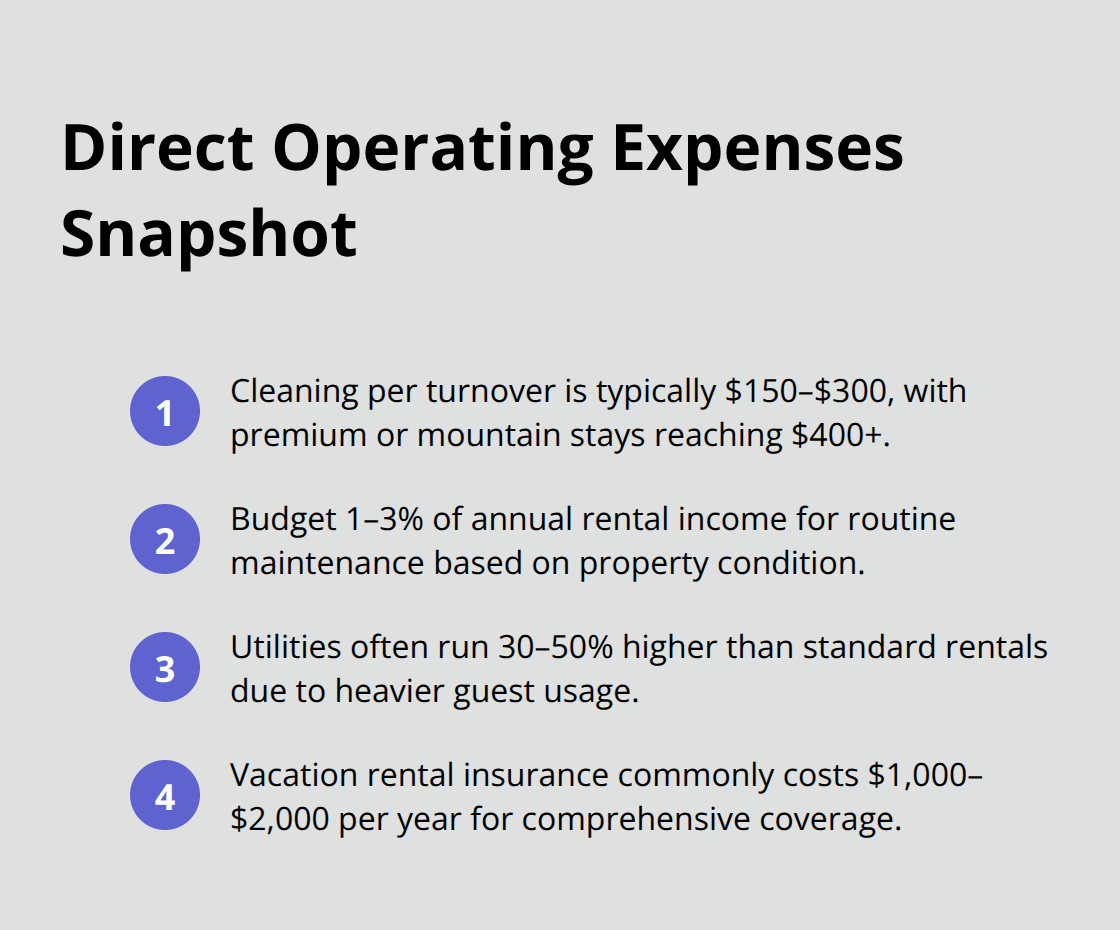
Cleaning represents your biggest direct expense, and turnover frequency determines how much you’ll spend. A property that books 30 nights monthly needs cleaning after nearly every guest, while one booked 15 nights requires half that work. Professional cleaning for a three-bedroom vacation rental typically costs $150 to $300 per turnover in most markets, though premium properties and mountain locations reach $400 or higher. If your property turns over 25 times annually, that’s $3,750 to $7,500 just for cleaning. Most owners mistakenly assume guest cleaning fees cover this cost-they don’t.
Airbnb cleaning fees that guests pay go into your revenue calculation, but you still pay your cleaner the full amount upfront. Some property managers bundle cleaning into their management fee, while others charge it separately; this distinction matters enormously when comparing quotes.
Maintenance and Repair Costs Follow Predictable Patterns
Maintenance costs follow a pattern that surprises new owners. Budget 1 percent of your property’s annual rental income for routine maintenance in a well-maintained home, and 2 to 3 percent if your property is older or has high-wear items like hot tubs or pools. A $50,000 annual rental income means $500 to $1,500 in maintenance annually for routine repairs. However, this is a floor, not a ceiling. One guest damages the HVAC system or a pipe freezes in winter, and you face $2,000 to $5,000 in emergency repairs. Northern Minnesota properties face specific challenges-winterization, snow removal, and seasonal maintenance add real costs that southern properties never encounter. Preventative maintenance actually reduces your total spending over time. A $300 annual HVAC inspection prevents a $2,000 compressor replacement. Wise owners set aside 1 to 2 percent of revenue monthly as a maintenance reserve, then draw from it as needed rather than scrambling for cash when problems arise.
Utilities and Insurance Demand Constant Attention
Utilities for vacation rentals cost significantly more than residential properties because guests use them heavily and care less about conservation. Expect to pay 30 to 50 percent more for water, electric, and gas than a standard rental property. A property with year-round bookings in Minnesota might run $200 to $400 monthly for utilities alone during winter months. Insurance is non-negotiable and standard homeowner policies do not cover short-term rentals. Vacation rental insurance typically costs between $1,000 and $2,000 annually for a comprehensive policy, depending on factors like property location and coverage limits. Some insurers charge higher premiums for properties with more than 20 bookings monthly. These costs are fixed or semi-fixed-they don’t fluctuate with occupancy the way cleaning does, which makes them particularly painful in slow seasons when bookings drop but your insurance bill stays constant.
These direct operating expenses form only part of your true cost picture. Hidden fees and management charges often exceed what owners anticipate, and understanding these charges separates profitable owners from those who struggle to break even.
What Management Companies Actually Charge
Understanding the Fee Range and Models
Property management fees consume 10 to 40 percent of your gross rental income, but this wide range hides critical differences in what you’re actually paying for. A 15 percent fee on a $50,000 annual revenue property costs $7,500 yearly, while a 30 percent fee on the same property runs $15,000. The difference isn’t just money-it reflects fundamentally different service models. Commission-based fees tie the manager’s earnings directly to your bookings, so they have financial incentive to fill your calendar. Fixed monthly fees, typically $200 to $500, provide predictability but don’t reward the manager for driving higher occupancy. Guaranteed income models, where you receive a set monthly payout and the manager keeps everything above that threshold, shift all seasonal risk onto the manager and rarely appear in practice because managers won’t accept that risk.
What Services Actually Hide Behind the Percentage
The real problem most owners face: they compare only the headline percentage without understanding what services that percentage actually covers. One manager’s 20 percent fee might include marketing, guest communication, cleaning coordination, and maintenance, while another company’s 20 percent covers only booking management and guest communication. Marketing fees often hide as separate charges beyond the base management fee-professional photography costs between $110 to $300 per project, multi-platform listing optimization adds another $50 to $200 monthly, and dynamic pricing tools run $25 to $75 per month.
Platform Fees and Hidden Booking Charges
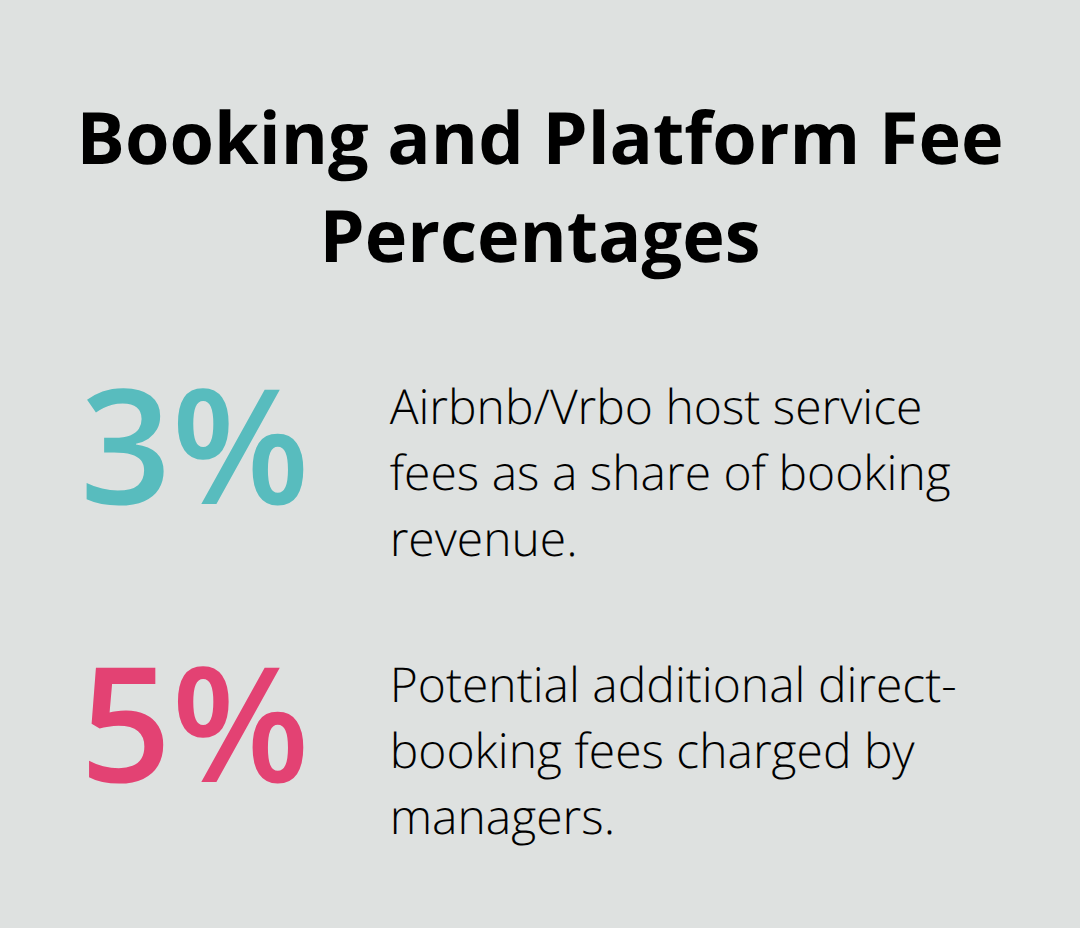
Booking platform fees vary dramatically depending on your strategy. Airbnb and Vrbo charge host service fees of 3 percent, but if your property manager charges additional booking fees for direct reservations, that can add 3 to 5 percent more to your costs. Some managers charge concierge and guest services fees separately, adding $100 to $300 monthly for 24/7 support, emergency coordination, and guest issue resolution.
Calculating Your True Total Cost
Calculate your total monthly cost by adding the base management percentage, all documented add-on fees, platform commissions, and any per-booking charges. A property generating $4,000 monthly revenue with a 25 percent management fee, $100 marketing fee, $50 booking platform fee, and $150 concierge charge costs $1,200 monthly before maintenance and cleaning. That’s 30 percent of revenue, not 25 percent. Request itemized fee breakdowns from any property manager and ask explicitly what services are included in the base fee versus what costs extra. Managers who won’t provide transparent fee structures typically hide expensive add-ons, and that’s a red flag worth heeding.
These management charges represent only one piece of your cost puzzle. Your actual profitability depends on understanding how seasonal fluctuations, local market rates, and net rental income calculations work together to determine whether your property generates real wealth or simply consumes your time and capital.
ROI Calculation and Profitability Analysis
Understanding Net Rental Income
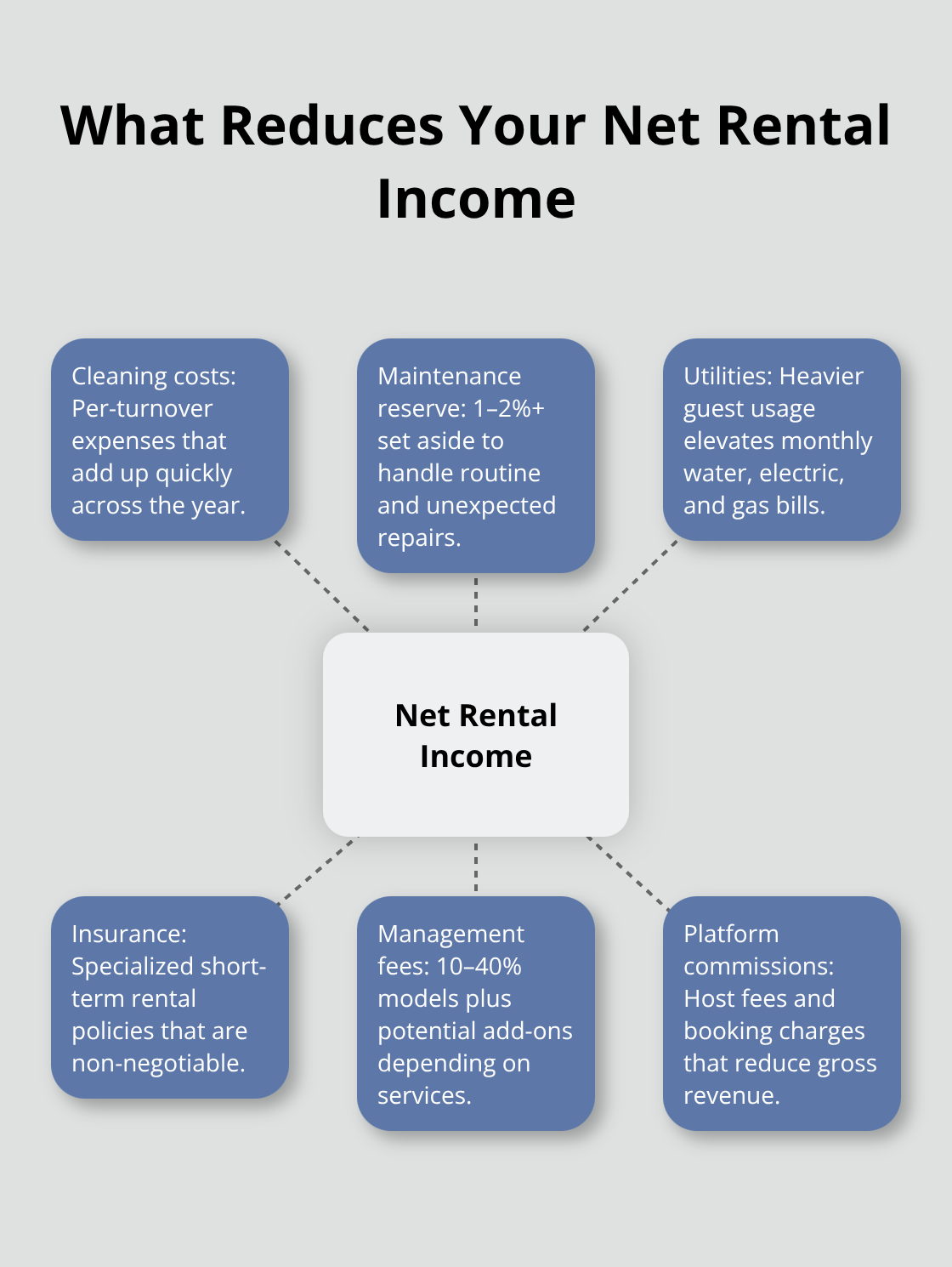
Net rental income is what remains after you subtract every single expense from your gross bookings, and most owners calculate this incorrectly. Start with your total annual revenue, then subtract cleaning costs, maintenance reserves, utilities, insurance, property management fees, and platform commissions. A property that generates $60,000 in annual bookings might look profitable until you subtract $12,000 in cleaning (20 turnovers at $600), $3,000 in utilities, $1,500 in insurance, $15,000 in management fees at 25 percent, and $1,800 in platform commissions. Your net rental income drops to $26,700, which is 45 percent of gross revenue.
That’s your actual profit before taxes. Many owners never perform this calculation and mistakenly believe their property generates far more income than it actually is. The gap between gross and net reveals whether your property truly works as an investment.
Seasonal Fluctuations and Cash Flow Planning
Properties in seasonal markets like Northern Minnesota face an additional layer of complexity because your costs don’t shrink when bookings do. Your insurance bill stays the same in January whether you book 5 nights or 15 nights. Your maintenance reserve must cover winter-specific expenses like snow removal and winterization whether occupancy is high or low. This forces you to front-load earnings during peak seasons to cover the lean months ahead.
Seasonal fluctuations destroy profitability for owners who fail to plan around them. Northern Minnesota properties typically generate 60 to 70 percent of annual revenue during June through September, while winter months produce minimal bookings but demand the same operational costs. Calculate your monthly net income across all four seasons, not just an annual average, because one profitable summer month cannot offset four unprofitable winter months if you lack capital reserves.
Benchmarking Against Local Market Rates
Compare your property’s performance against comparable local rentals using Airbnb’s public pricing data and local vacation rental market reports to determine whether you’re positioned correctly for your market. Properties that underperform their local benchmarks often suffer from poor marketing, outdated listings, or pricing that doesn’t match market demand. If your property generates 40 percent less occupancy than similar properties in your area, the problem is rarely the market itself. Adjust your marketing strategy, refresh your photography, or reconsider your nightly rate before blaming external factors.
Properties that consistently outperform local benchmarks typically have professional management, invest in quality guest experiences, and price dynamically based on demand patterns rather than using static rates year-round. Your true return on investment only becomes visible when you compare your net annual income against your total property investment, accounting for the capital required and the time spent on operations.
Final Thoughts
Calculating vacation property management costs accurately transforms how you evaluate your investment. The three cost categories covered in this guide-direct operating expenses, management fees, and seasonal fluctuations-determine whether your property generates genuine wealth or simply drains your capital. Most owners discover their true profitability only after tracking these expenses for a full year, and incomplete information leads to poor pricing and operational decisions.
Start with an itemized list of every expense category specific to your property. Cleaning costs depend on your turnover frequency, maintenance reserves should reflect your property’s age and location, utilities and insurance are non-negotiable, and management fees vary wildly depending on what services are actually included. Request detailed fee breakdowns from any property manager and calculate your net rental income by subtracting all expenses from gross revenue-this single calculation reveals whether your property works as an investment.
Northern Minnesota properties face unique cost pressures that southern rentals never encounter (winterization, snow removal, and seasonal maintenance add real expenses that must factor into your annual budget). Plan your cash flow around seasonal fluctuations rather than assuming an average monthly income, because winter months will test your financial reserves. We at Up North Property Management handle the complexity of vacation property management costs for owners throughout Northern Minnesota, and professional vacation rental management removes the guesswork from expense tracking and occupancy optimization.