

A vacation rental property management agreement is the foundation of a successful landlord-manager relationship. Without a clear, legally sound document, disputes over responsibilities, fees, and liability can quickly spiral into costly problems.
We at Up North Property Management have seen firsthand how a poorly drafted agreement creates friction and confusion. This guide walks you through the essential elements, legal requirements, and common mistakes to avoid when creating your sample vacation rental property management agreement.
What Your Agreement Must Cover
Define Services and Responsibilities Clearly
Your vacation rental agreement needs to spell out exactly what the manager will and won’t do, because vague language is where landlord-manager relationships fall apart. The National Association of Realtors emphasizes that a well-drafted agreement should clearly define the scope of services, including bookings, guest communications, housekeeping coordination, maintenance, and pricing optimization. State what’s included in the base management fee and what costs extra. If your manager handles dynamic pricing across Airbnb and VRBO, that should appear in writing. If emergency repairs require owner approval above $500, that cap needs to be in the contract. The American Hotel & Lodging Association recommends breaking down pass-through costs separately so owners understand exactly which expenses are management fees versus itemized charges like cleaning supplies, platform commissions, and contractor fees. This transparency prevents disputes later.
Set Clear Contract Duration and Exit Terms
Duration matters significantly. Most vacation rental agreements run 12 months initially, though some managers offer month-to-month terms after the first year. The key is defining how either party exits the relationship. Standard practice requires 30 to 90 days written notice, and your agreement should specify what happens to outstanding payments, guest deposits, and property data when the contract ends. If a manager hasn’t booked guests within a defined timeframe, that should trigger a performance-based termination option. Without clear exit terms, you could remain locked into paying fees for a manager who isn’t delivering results.
Choose the Right Fee Structure
Fee structure makes or breaks the deal. Vacation rental managers typically charge either a flat monthly fee or a percentage of rental income, and each approach carries real consequences. Percentage-based fees range from roughly 15 to 40 percent of revenue according to industry standards, and they incentivize managers to maximize bookings and pricing. Flat fees-say $450 monthly-give you predictable costs regardless of occupancy.
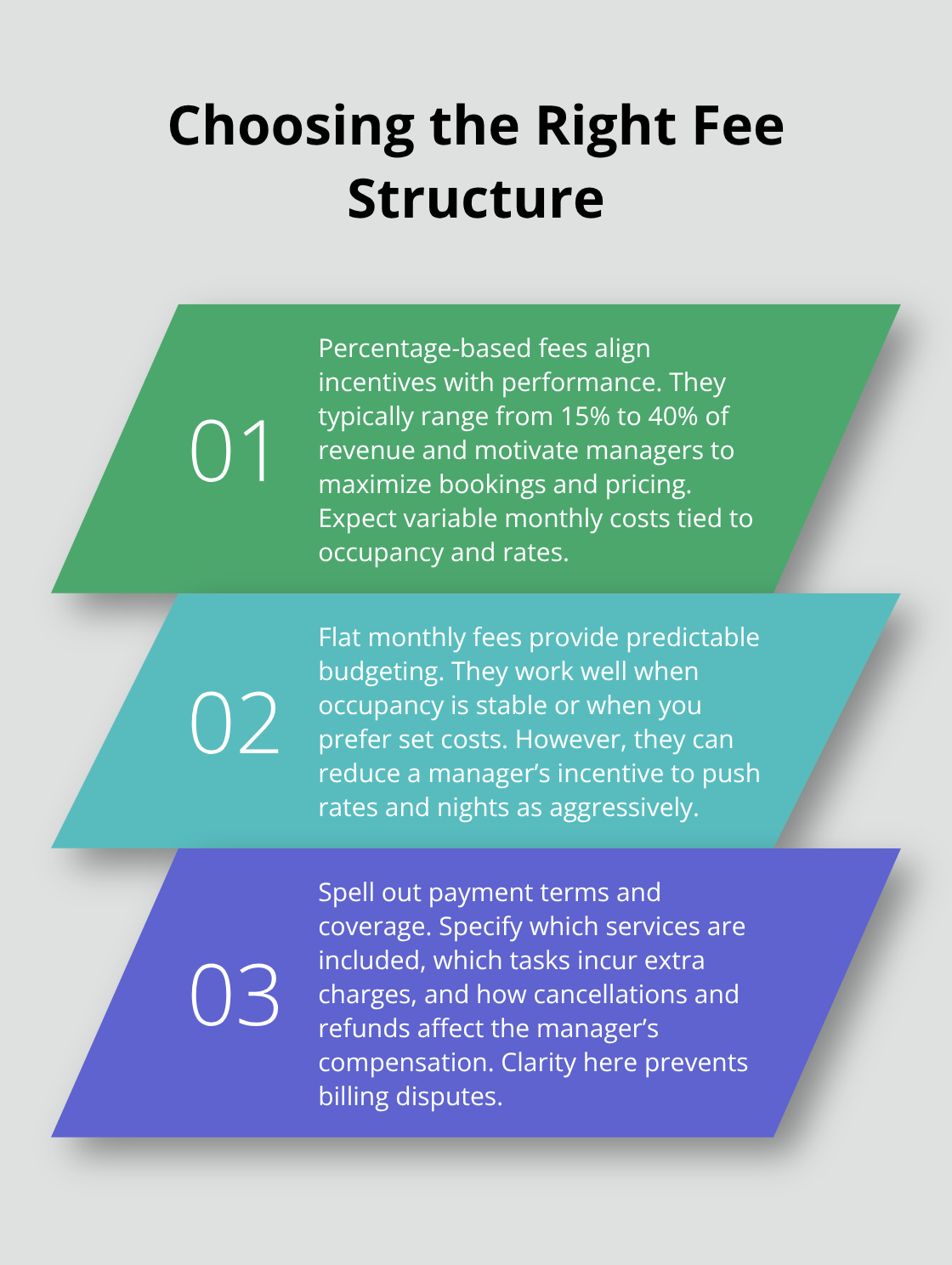
The trade-off is that flat-fee managers have less financial motivation to push occupancy hard. Your agreement should state the fee clearly, specify whether it covers all services or if certain tasks carry additional charges, and outline the payment schedule. Include what happens if a guest cancels or requests a refund. Does the manager’s fee still apply? How are cleaning fees and pet charges handled?
Handle Revenue and Tax Reporting
The IRS Publication 527 notes that owners must track which expenses are deductible, so your agreement should clarify whether the manager collects rent directly or if payments flow through the owner. This affects tax reporting and cash flow. Also address when the owner receives payouts. Monthly statements are standard, but some managers hold funds longer. Specify the exact payout schedule and calculation method so there’s no guesswork. Your agreement should also detail how the manager treats cancellations, refunds, and platform fees to align with your tax obligations.
With the right fee structure and clear revenue terms in place, you’re ready to address the legal requirements that protect both you and your manager.
Legal and Compliance Requirements for Your Agreement
State and Local Regulations Shape Your Contract
Your vacation rental agreement must comply with state and local regulations, or you risk fines, liability claims, and contract enforceability issues. Each state treats vacation rentals differently, and some municipalities require specific licensing, occupancy limits, or tax registration before you can legally operate. Minnesota, for example, requires property owners to register with the state if they rent short-term, and many cities impose local licensing fees ranging from $100 to $500 annually. Your agreement should explicitly reference these local requirements and state which party handles compliance.
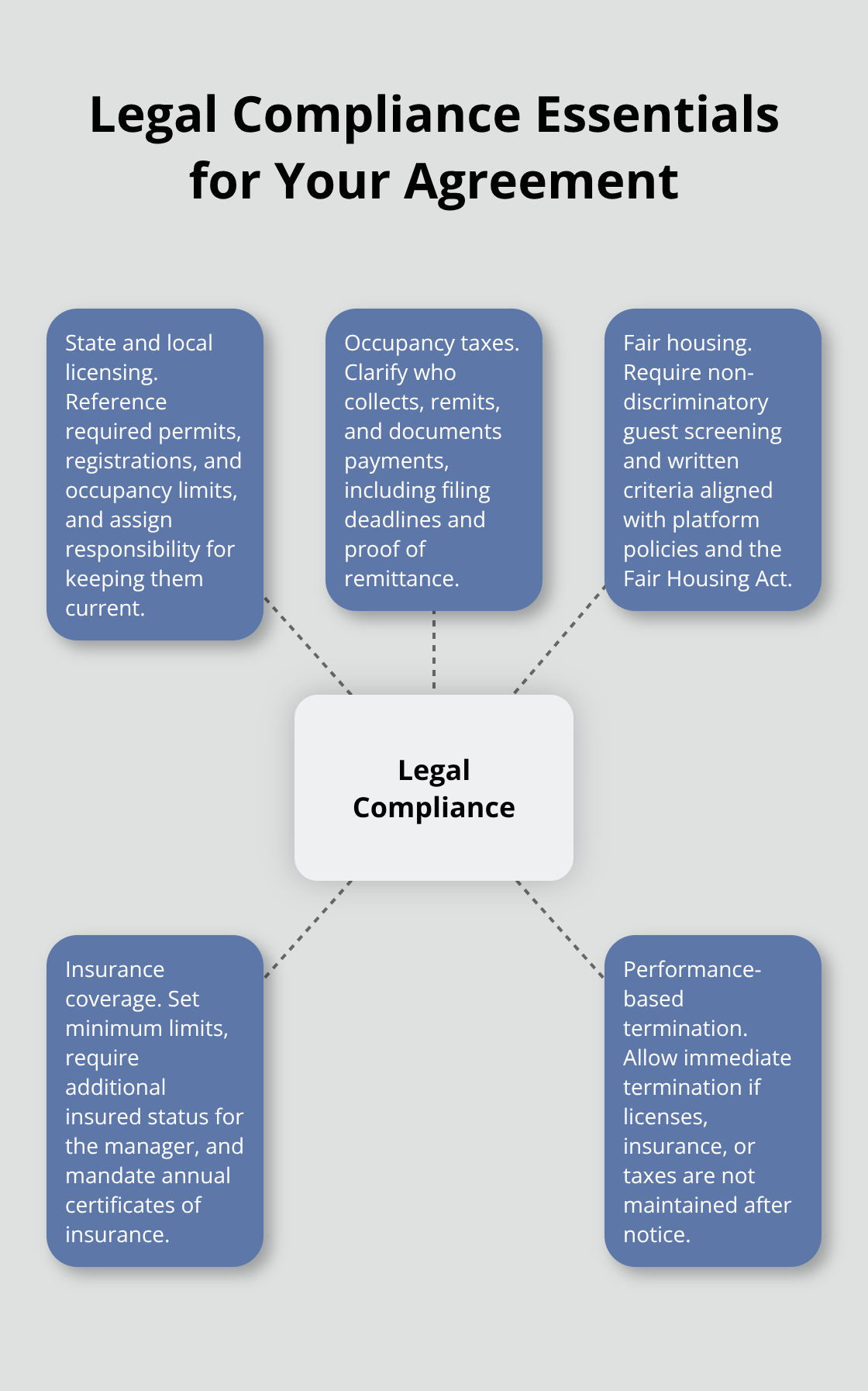
If your manager fails to secure required permits or licenses, that becomes grounds for immediate termination.
Tax Reporting and Income Documentation
The IRS Publication 527 clarifies that rental income from vacation properties is fully taxable, and owners must report all revenue regardless of how the manager structures payments. Your contract must specify whether the manager files Form 1099s for contractors they hire or whether you handle that separately. Most vacation rental managers use percentage-based fees because it simplifies tax reporting-the manager takes their cut before the owner receives payouts-but you need that payment flow documented in writing to avoid IRS disputes later. Occupancy taxes add another layer. Many states impose occupancy taxes on vacation rentals, and the manager typically collects and remits these on behalf of the owner. Your agreement must clarify who files occupancy tax returns and by what deadline. In Minnesota, occupancy tax is due monthly to the state. If the manager fails to remit taxes, you remain liable for penalties and interest. Include a clause requiring the manager to provide quarterly occupancy tax documentation and proof of payment.
Fair Housing and Guest Screening Standards
Fair housing laws apply to vacation rentals too, though enforcement varies by jurisdiction. The Fair Housing Act prohibits discrimination based on protected characteristics, and your agreement should require the manager to screen guests fairly and document their screening criteria. If a manager rejects guests based on family size, national origin, or disability status, you face liability alongside them. State your guest screening process in the contract and require the manager to maintain written records. Many platforms like Vrbo now require hosts to acknowledge fair housing obligations, so align your agreement language with platform policies.
Insurance Requirements Protect Both Parties
Insurance is non-negotiable and should be mandatory in your contract. Require the owner to maintain property insurance with minimum coverage limits-typically $300,000 to $500,000 for vacation rentals-and mandate that the manager is named as an additional insured. The manager should carry general liability insurance covering guest injuries. Your agreement should require annual proof of insurance via certificate of insurance and specify what happens if coverage lapses. Without clear insurance requirements, a guest injury could leave both you and your manager personally liable.
Performance-Based Termination for Compliance Failures
Performance-based termination is your safety net if compliance breaks down. If the manager fails to file required licenses, maintain insurance, or remit taxes within 30 days of a written notice, you should have the right to terminate immediately without penalty. This protects you from remaining locked into an agreement with someone who ignores legal obligations. With these legal protections in place, you’re ready to identify the common pitfalls that trip up even experienced property owners and managers.
Mistakes That Destroy Vacation Rental Agreements
Ambiguous Language Creates Costly Disputes
Ambiguous contract language is the primary reason property owners and managers end up in disputes that cost thousands to resolve through mediation or litigation. When your agreement states the manager will handle maintenance but fails to define what qualifies as routine versus emergency repairs, conflicts emerge fast. One owner discovered their manager approved a $3,000 roof repair without authorization because the contract failed to set a dollar threshold for approval. Another found their manager interpreted housekeeping coordination as inspecting cleaners’ work, not actually managing the cleaning schedule. The American Hotel & Lodging Association recommends defining every major service with specific examples and approval processes. Instead of writing that the manager handles maintenance, state: the manager approves routine maintenance under $500 without owner consent, emergency repairs require immediate owner notification and approval before work begins, and major repairs exceeding $2,000 require written owner authorization. Include response time expectations too. If a guest reports a broken toilet at 9 PM, does the manager have 2 hours to respond or 24 hours? Vague timelines create liability exposure because guests may withhold payment or leave negative reviews citing poor service, which damages your occupancy rate and revenue.
Insurance and Liability Gaps Leave You Exposed
Insurance and liability gaps expose you to catastrophic financial risk that contract ambiguity cannot protect against. Require the property owner to maintain minimum coverage of at least $1 million and mandate the manager is named as additional insured on the policy. Many owners skip this step because they assume their homeowner’s policy covers vacation rentals, but standard homeowner policies explicitly exclude short-term rental income. When a guest is injured on the property and files a claim, the insurance company denies coverage because the property was being used commercially. You and your manager face personal liability for medical bills, lost wages, and pain and suffering damages that easily exceed $100,000. Your agreement must require annual proof of insurance via certificate of insurance and specify termination rights if coverage lapses.
Undefined Communication Channels Damage Guest Experience
Communication protocols fail when the agreement lacks defined channels and response expectations, creating situations where urgent guest issues go unresolved for hours. Specify whether the manager responds to guest questions via email, phone, or a dedicated property management platform, and set maximum response times for different issue types. Guest check-in problems warrant a 15-minute response window. Maintenance requests should receive acknowledgment within 2 hours and resolution within 24 hours for non-emergency issues. Without these specifics written into the contract, guests experience poor service, leave damaging reviews, and occupancy rates drop. The Federal Trade Commission emphasizes that clear communication channels reduce guest complaints and protect your property reputation, which directly impacts your revenue since 73 percent of travelers read guest reviews before booking according to travel industry data.

Final Thoughts
A strong sample vacation rental property management agreement protects both you and your manager by eliminating ambiguity, defining responsibilities, and establishing clear financial terms. Your agreement should include specific service descriptions with dollar thresholds for repairs, detailed fee structures that align incentives, mandatory insurance requirements with proof of coverage, and defined communication protocols with response time expectations. Before you finalize your contract, have an attorney licensed in your state review the document to confirm it complies with local regulations and is enforceable (many property owners skip this step to save money, then spend thousands resolving disputes that a legal review would have prevented).
If you manage a vacation rental in Northern Minnesota, Up North Property Management handles the operational complexity so you don’t have to. We manage marketing, bookings, cleaning, and maintenance while your property stays in top condition and generates consistent income. Whether you decide to self-manage with a solid agreement or partner with an experienced manager, the foundation remains the same: a clear, legally sound contract that defines expectations and protects your investment.