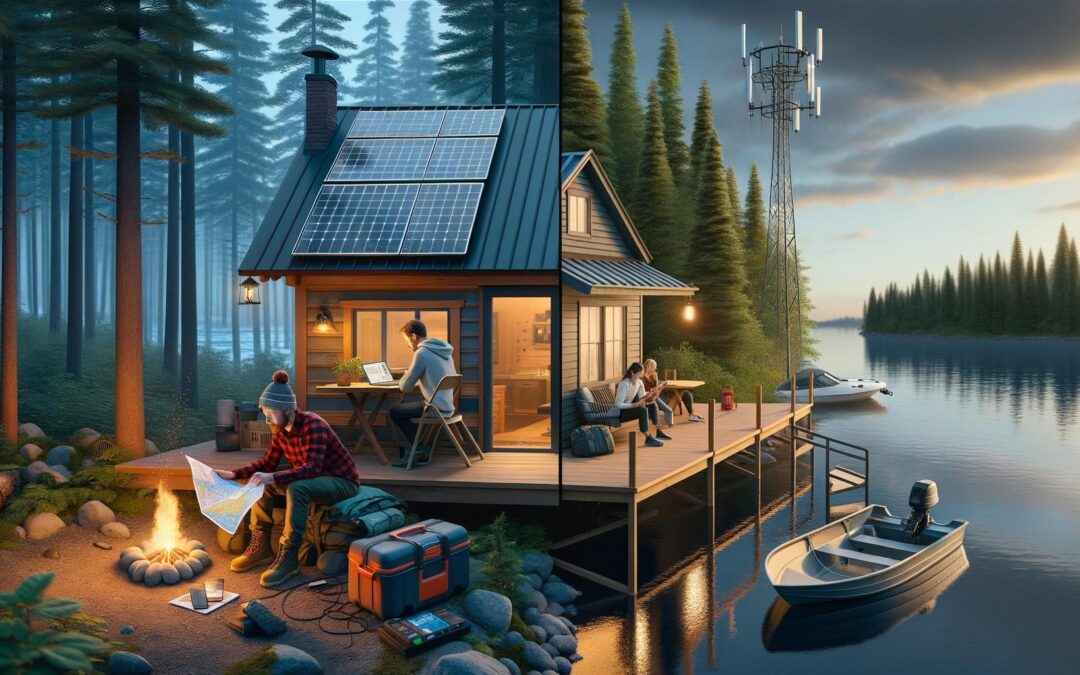
Choosing between an off-grid cabin and a connected property in Minnesota comes down to your priorities and budget. Off-grid cabins offer independence and lower operating costs, while connected cabins provide modern conveniences and reliable cabin utilities.
We at Up North Property Management help owners navigate this decision by weighing the financial, practical, and guest experience factors that matter most to your rental business.
Why Off-Grid Cabins Cost Less to Operate
Off-grid cabins in Minnesota eliminate monthly utility bills that connected properties face year-round. A connected cabin typically costs $150 to $300 monthly for electricity alone during winter months when heating demands peak, plus water and sewage fees that add another $50 to $100. Off-grid systems powered by solar panels and battery storage remove these recurring expenses entirely. The U.S. Department of Energy confirms that properties relying on renewable energy and alternative water systems reduce operational costs by 40 to 60 percent annually compared to grid-connected homes. Property taxes often reflect lower assessed values for off-grid cabins since they lack expensive utility infrastructure connections.
Minnesota county assessors typically value off-grid properties at 10 to 15 percent less than comparable connected cabins, which directly lowers your annual tax burden. For a cabin assessed at $250,000, this difference translates to roughly $300 to $450 in annual savings on property taxes alone.
The Real Cost of Independence
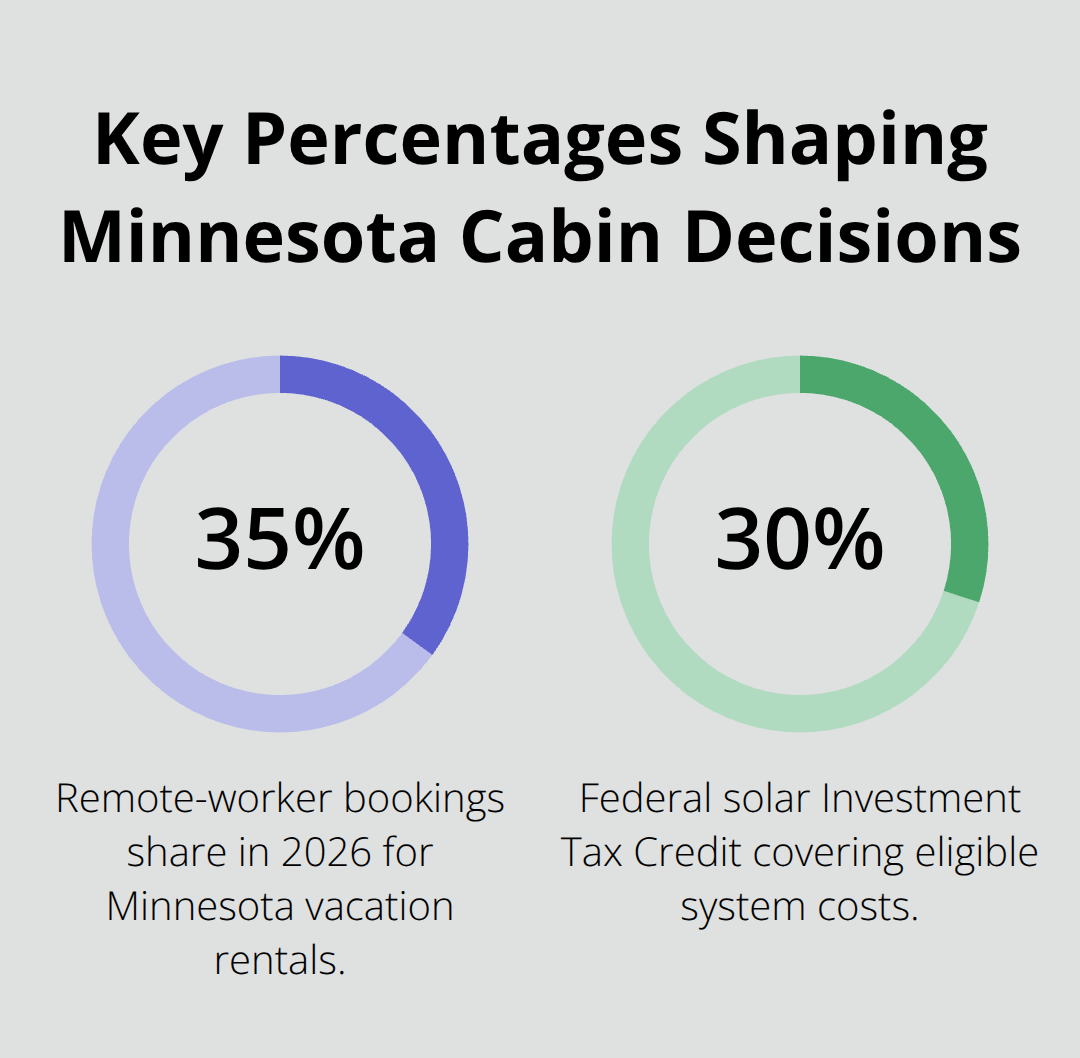
Independence from utility infrastructure means you control your operating budget completely. A well-designed off-grid cabin in Minnesota requires upfront investment in solar panels ($10,000 to $30,000 for a complete system according to the U.S. Department of Energy), battery storage ($5,000 to $15,000), and a reliable backup generator ($3,000 to $8,000). These costs seem substantial until you calculate the payback period. Most off-grid Minnesota cabins recoup their renewable energy investment within 8 to 12 years through eliminated utility payments, especially if you apply the federal solar investment tax credit which currently covers 30 percent of eligible system costs. After that payback period, your cabin operates almost cost-free, which dramatically improves long-term profitability for vacation rental owners. Well drilling costs range from $3,000 to $15,000 depending on depth, and septic systems run $3,500 to $8,500, but these are one-time expenses that never increase with inflation like municipal utility rates do.
What Guests Seek in Off-Grid Properties
Off-grid cabins appeal to guests who seek authentic Minnesota wilderness experiences without sacrificing comfort. The sustainability angle attracts environmentally conscious travelers willing to pay premium nightly rates for properties featuring solar power, rainwater collection systems, and composting toilets. Minnesota’s eco-tourism market shows strong demand for vacation rentals that demonstrate genuine environmental commitment rather than greenwashing. Properties that highlight off-grid systems in their listings report 15 to 20 percent higher booking rates than standard cabins in comparable locations. Off-grid cabins also require less maintenance during winter months since you avoid frozen pipes connected to municipal water systems or utility company service interruptions during Minnesota’s frequent winter storms. This reliability matters significantly for vacation rental owners who manage properties remotely during harsh seasons.
Connected cabins offer a different value proposition entirely-one that centers on convenience, modern technology, and the predictability that guests expect from contemporary vacation rentals.
Why Connected Cabins Win on Guest Satisfaction
Connected cabins dominate Minnesota’s vacation rental market because guests expect reliable internet, consistent heating, and the ability to shower without worrying about water shortages. High-speed fiber internet transforms a remote Minnesota cabin into a functional workspace, which matters enormously in 2026 when roughly 35 percent of vacation rental bookings come from remote workers seeking extended stays. A cabin with symmetrical gigabit speeds supports video conferencing, cloud backups, and streaming simultaneously without degradation, while properties relying on satellite internet face latency issues that frustrate professional guests.
Climate Control That Works Automatically
Connected properties guarantee consistent indoor temperatures during Minnesota winters, which reach below freezing for five months annually. A connected cabin with a modern heat pump system maintains 70 degrees reliably, whereas off-grid systems dependent on wood stoves or propane heaters require active management and fuel monitoring. Guests paying $200 to $400 nightly expect climate control to work automatically, not require their participation.
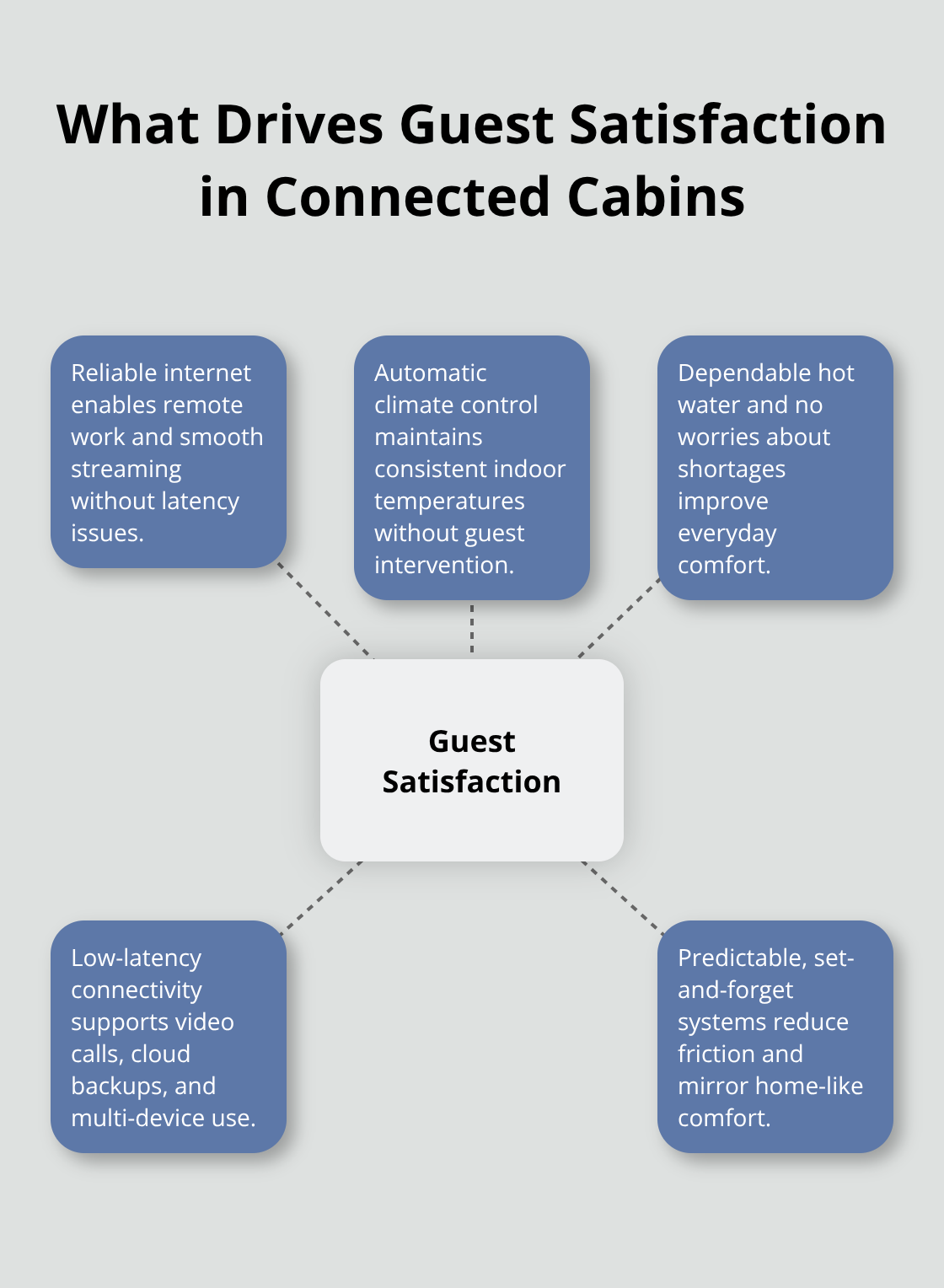
This expectation reflects how modern travelers view vacation rentals-as extensions of their home comfort, not as rustic experiments.
Revenue Advantage of Connected Properties
The financial reality strongly favors connected cabins for vacation rental owners seeking maximum occupancy and premium pricing. Connected cabins command 25 to 35 percent higher nightly rates than comparable off-grid cabins, according to vacation rental market analysis from platforms tracking Minnesota properties. A connected cabin in Northern Minnesota books 60 to 70 percent of available nights annually, while off-grid properties average 45 to 55 percent occupancy because they appeal to a narrower guest demographic. This occupancy gap translates directly to revenue: a connected cabin generates $45,000 annually while an off-grid property in the same location earns $30,000.
Resale Value and Market Perception
Resale value reinforces this advantage dramatically. Connected cabins with utility infrastructure, municipal water hookups, and reliable power typically sell for 20 to 30 percent more than off-grid equivalents with identical square footage and location. Minnesota real estate markets treat grid-connected properties as lower-risk investments, which attracts broader buyer pools when you eventually exit the rental business. An off-grid cabin assessed at $250,000 might sell for $220,000 when market conditions shift, while a connected cabin in the same area maintains $280,000 to $300,000 asking prices because future buyers view utility connections as essential infrastructure rather than optional upgrades.
These financial advantages create a compelling case for connected properties, yet the decision ultimately depends on your specific goals and the location you’ve selected for your Minnesota cabin investment. The next section examines the key differences between these two approaches and helps you determine which aligns with your vision for a vacation rental business.
Key Differences Between Off-Grid and Connected Properties
The financial gap between off-grid and connected cabins widens dramatically when you factor in real-world Minnesota conditions and guest expectations. Off-grid properties demand $15,000 to $50,000 in upfront infrastructure costs for solar, battery storage, wells, and septic systems, while connected cabins require only $5,000 to $10,000 in utility connection fees and hookup labor. This initial difference matters less than the long-term operational reality: a connected cabin with grid power costs $150 to $300 monthly for electricity during brutal Minnesota winters, but those expenses stabilize and remain predictable. Off-grid cabins eliminate this recurring cost entirely, yet they introduce a different financial burden-battery replacement every 10 to 15 years costs $5,000 to $12,000, and solar panel efficiency degrades roughly 0.5 percent annually after installation. The Department of Energy data shows that off-grid systems in Minnesota recoup their investment within 8 to 12 years through eliminated utility payments, but only if you plan to own the property long-term. For vacation rental owners expecting to sell within 5 to 7 years, the math favors connected properties because resale value increases 20 to 30 percent compared to off-grid equivalents in the same location and condition.
Maintenance demands separate these two approaches fundamentally
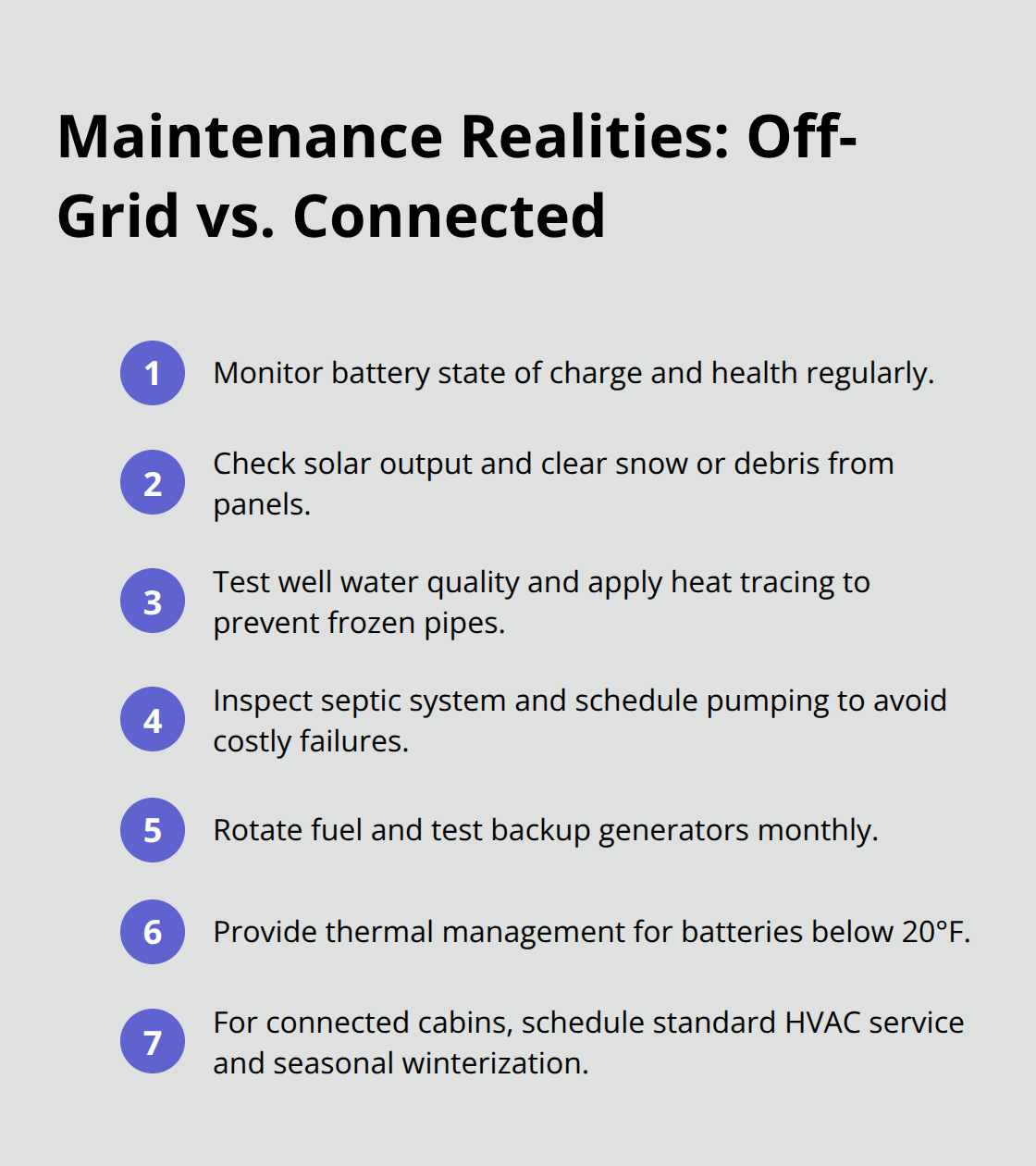
Connected cabins require seasonal winterization and standard HVAC maintenance, typically costing $500 to $1,500 annually. Off-grid systems demand constant monitoring-you must check battery charge levels, monitor solar panel output, test water quality from your well, and maintain septic systems to prevent catastrophic failures that cost $8,000 to $15,000 to repair. Minnesota winters create specific challenges: frozen pipes in off-grid wells demand heat tracing and insulation, backup generators need fuel rotation and testing monthly, and battery banks lose efficiency below 20 degrees Fahrenheit without proper thermal management. Connected cabins sidestep these complications entirely.
A guest arriving at a connected cabin expects hot water immediately, reliable heating, and functional toilets without understanding the infrastructure behind them. Off-grid cabins require guests who either understand the systems or accept that showers might run cold if cloud cover depletes batteries faster than expected.
Guest expectations drive occupancy rates higher for connected properties
This reality explains why connected cabins average 60 to 70 percent annual occupancy while off-grid properties hover at 45 to 55 percent-guests booking a $300 nightly vacation rental expect convenience, not system management. Connected properties command 25 to 35 percent higher nightly rates because they deliver predictable comfort that off-grid cabins cannot match, particularly during Minnesota’s five-month winter season when guests increasingly prioritize reliable climate control over sustainability credentials. The occupancy gap translates directly to revenue: a connected cabin generates roughly $45,000 annually while an off-grid property in the same location earns approximately $30,000. Resale value reinforces this advantage dramatically. Connected cabins with utility infrastructure, municipal water hookups, and reliable power typically sell for 20 to 30 percent more than off-grid equivalents with identical square footage and location. Minnesota real estate markets treat grid-connected properties as lower-risk investments, which attracts broader buyer pools when you eventually exit the rental business.
Final Thoughts
Connected cabins win for Minnesota vacation rental owners who prioritize revenue and resale value. The numbers prove this decisively: connected properties generate $45,000 annually compared to $30,000 for off-grid equivalents in comparable locations, command 25 to 35 percent higher nightly rates, and sell for 20 to 30 percent more when you exit the rental business. Guests expect reliable cabin utilities, high-speed internet, and automatic climate control during Minnesota winters-expectations that off-grid systems struggle to meet consistently.
Off-grid cabins make sense only if you plan long-term ownership and target environmentally conscious travelers willing to accept operational complexity. The 8 to 12 year payback period on renewable energy systems requires patience that most vacation rental owners cannot afford, and winter maintenance demands plus battery replacement costs ($5,000 to $12,000 every 10 to 15 years) create ongoing financial burdens that connected properties eliminate entirely. Your location matters significantly in this decision-Northern Minnesota properties near established tourism corridors benefit enormously from connected infrastructure, while rural properties far from utilities face substantial connection costs that may justify off-grid systems economically.
We at Up North Property Management help owners navigate this decision by analyzing your property’s location, target guest profile, and financial timeline. Our team manages the operational complexity that either choice demands, whether coordinating with utility providers for connected properties or monitoring renewable energy systems for off-grid cabins. Contact us to discuss which approach aligns with your vacation rental goals and let us handle the management details while you focus on building your investment.