

Lakefront property ownership comes with a price tag most owners don’t anticipate. Beyond the mortgage and property taxes, hidden maintenance costs can drain your budget fast.
At Up North Property Management, we’ve seen firsthand how lakefront maintenance costs catch owners off guard. This guide breaks down the expenses you need to plan for.
Water Damage and Foundation Issues
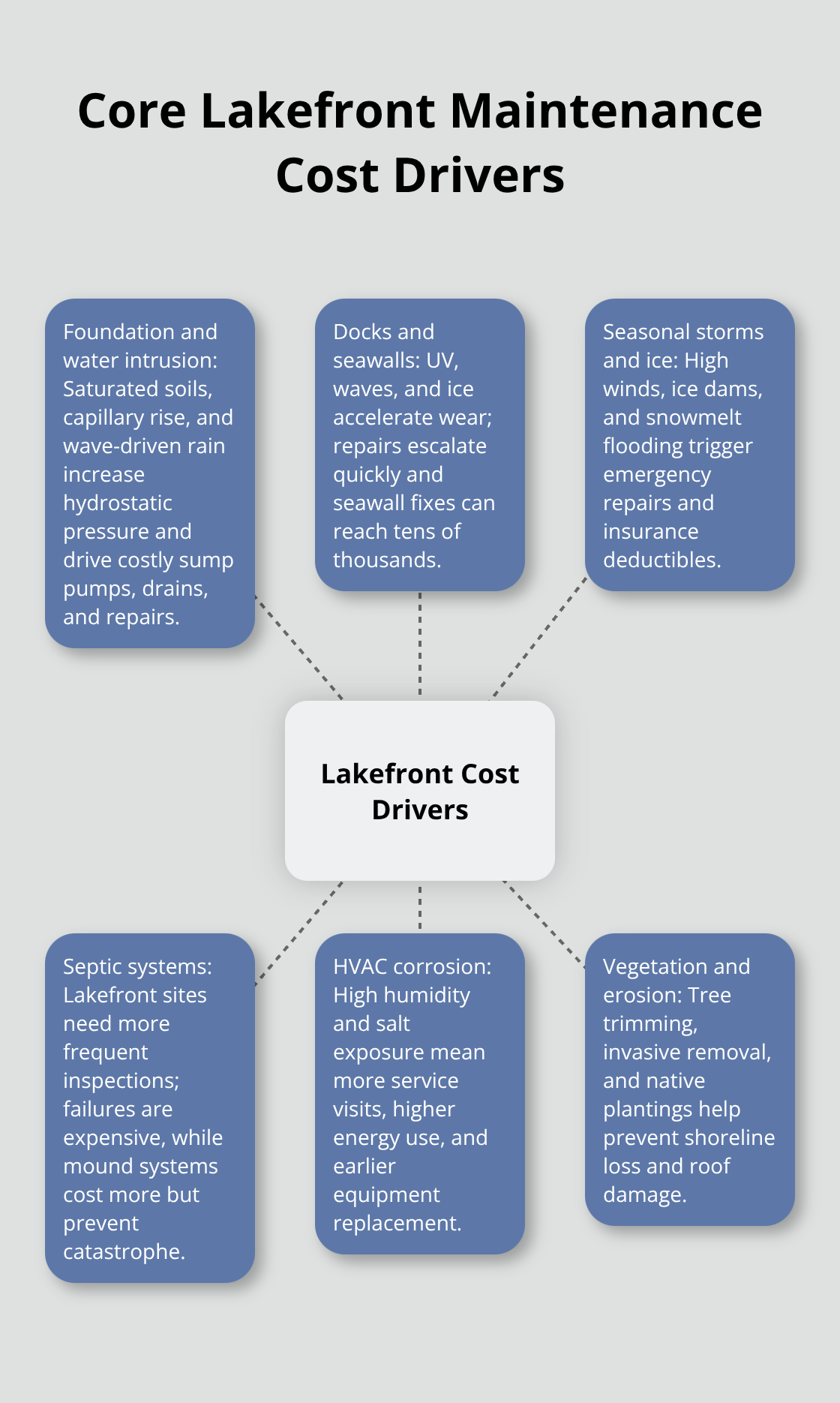
Moisture attacks lakefront properties from multiple directions and causes damage that spreads fast. Water seeps into foundations through soil saturation, rises through capillary action during spring thaw, and penetrates walls during heavy rain and wave action. Water level fluctuations in northern lakes swing 2-3 feet seasonally, meaning your foundation experiences constant pressure changes. This isn’t theoretical-it’s a practical reality that demands immediate attention. You need a sump pump system installed and maintained, which costs $1,500-$3,000 upfront, plus $200-$400 annually for inspections and repairs. French drains around the foundation run another $1,500-$5,000 depending on lot size. If you skip these measures, foundation repairs can exceed $25,000 when water damage becomes severe.
Dock and Pier Deterioration Accelerates Faster Than You Think
Your dock sits under constant assault from water, temperature swings, and UV exposure. Wooden docks typically last 20-30 years, depending on materials, maintenance, and water conditions. Repairs start small-replacing a few planks costs $500-$1,500-but escalate quickly when supports rot. A full dock replacement runs $3,000-$15,000 or more depending on size and materials. Winter proves particularly brutal in Northern Minnesota; ice expansion cracks pilings and heaves decking, requiring spring repairs that most owners don’t budget for. Aluminum docks cost more initially ($5,000-$20,000) but last longer and require less maintenance. Seawalls protecting your shoreline cost $100-$800 per linear foot to repair, with small cracks running $100-$180 and panel replacement at $450-$600 each. A 50-foot seawall showing signs of leaning or joint separation requires $5,000-$40,000 in repairs. The real trap is waiting until damage becomes visible; the problem has already spread beneath the surface and costs multiply.
Waterproofing Demands Regular Maintenance and Investment
Exterior caulking, sealants, and waterproof coatings deteriorate faster on lakefront properties due to humidity, salt spray in some regions, and UV damage. You should reseal exterior caulking annually, a task costing $500-$2,000 depending on home size. Deck sealing runs $300-$1,000 per application and needs repeating every 2-3 years. Window and door seals fail more frequently near water; expect to budget $200-$600 per replacement. Interior moisture problems demand dehumidifiers, which add $50-$200 monthly to electricity bills during humid months. Mold remediation, if moisture control fails, costs $2,000-$6,000 and sometimes much more in severe cases.
Catching Problems Early Saves Thousands
Inspect your home’s exterior caulking, window frames, and deck boards quarterly, especially after winter thaw and before autumn storms. Small gaps that cost $100 to seal now become $5,000 problems when water penetrates the structure. This foundation work sets the stage for understanding how seasonal weather compounds these moisture challenges-a topic we’ll address next.
Seasonal and Weather-Related Repairs
Northern Minnesota’s seasonal extremes attack lakefront properties with relentless force, and the repair costs follow a predictable pattern that catches most owners unprepared. Storm damage ranks as the leading cause of emergency repairs at lakefront homes. Wind speeds exceeding 40 mph tear shingles, crack siding, and snap tree branches that puncture roofs and damage structures. A single storm costs in repairs, with roof damage alone running $3,000–$15,000 depending on the extent of impact. Insurance covers some damage, but deductibles typically run $1,000–$5,000, meaning you absorb significant costs immediately.
Ice Damage Compounds Over Months
Winter ice damage proves even more insidious because it happens slowly and compounds over months. Water that seeps into cracks freezes, expands, and splits materials apart. Gutters clogged with leaves trap water that freezes solid, pulling gutters away from the fascia at a cost of $500–$2,000 to repair. Ice dams form along rooflines when heat escapes through the attic, and the melted snow that pools behind can leak back under the roof shingles and into your home. Removing ice dams costs $300–$800 per occurrence, and northern Minnesota experiences multiple ice dam events annually in older homes lacking proper attic ventilation.
Pipe freezing hits hardest in unheated seasonal properties. Water in exposed pipes freezes solid, ruptures the pipe, and floods the interior when thaw occurs. Winterization costs $300–$600 annually but prevents burst pipes that repair for $2,000–$10,000.
Flooding From Snowmelt and Heavy Rain
Flooding from rapid snowmelt and heavy rain creates a different threat. A one-inch water level rise causes nearly $25,000 in damage to surrounding buildings according to flood risk studies. Lakefront properties sit in flood zones where water tables rise dramatically during spring thaw, pushing water pressure against foundations and through basement walls. Sump pump systems handle moderate water intrusion, but intense flooding overwhelms standard systems. Backup sump pumps cost $1,500–$3,000 installed and activate automatically when primary pumps fail.
If your property sits in a flood zone, flood insurance costs $800–$2,000 annually and covers structural damage but excludes outdoor structures, vehicles, and detached garages. Water level fluctuations in northern lakes swing 2–3 feet seasonally, destabilizing shorelines and docks. Properties with eroding banks lose 1–3 feet of land annually in severe cases, requiring riprap placement or seawall repair to halt the process.
Prevent Damage Through Seasonal Maintenance
Roof inspections in late summer catch missing shingles and deteriorated flashing before fall storms hit. Gutter cleaning in September prevents ice dam formation by ensuring water flows freely. Tree trimming in early fall removes branches that will snap under snow and ice weight. HVAC system maintenance in October ensures your heating works reliably throughout winter.
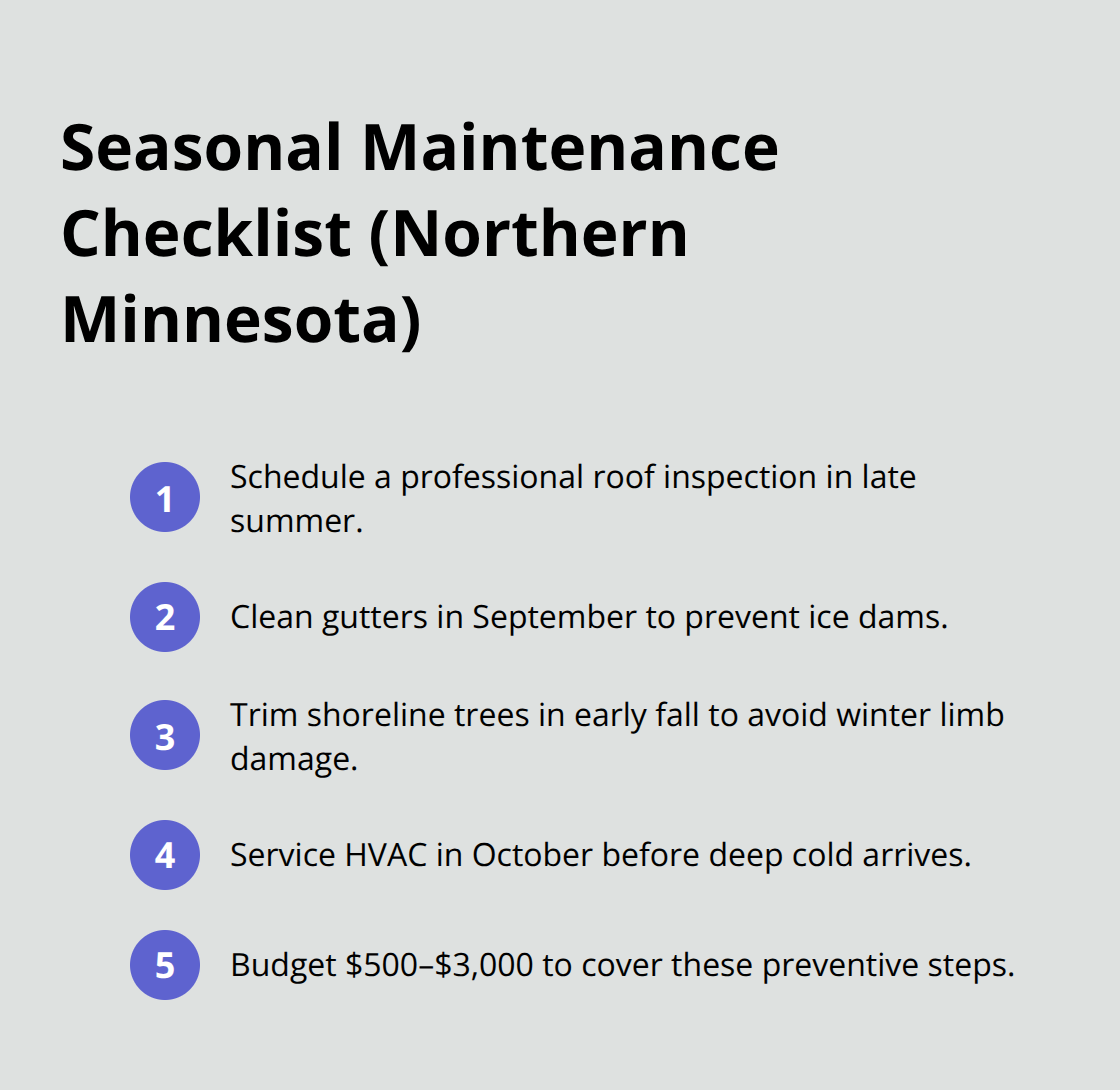
These preventive steps cost $500–$3,000 combined but eliminate the majority of seasonal emergency repairs that cost 5–10 times more.
Build a Reserve Fund for Seasonal Damage
Plan to set aside $3,000–$8,000 annually for seasonal repairs at a typical lakefront home. This covers small storm damage, ice dam removal, pipe winterization, and minor flood mitigation. Properties in high-risk flood zones or with aging structures should budget toward the upper range. Homeowners who skip this planning invariably face financial strain when a single storm or ice event demands immediate attention, forcing expensive emergency contractor rates and decisions made under pressure rather than through careful planning. Beyond seasonal weather, lakefront systems themselves-septic systems, HVAC equipment, and specialized landscaping-demand attention and investment that inland properties simply don’t require.
Lakefront Systems That Demand Specialized Care
Septic systems near water bodies operate under pressure that inland properties never face. Northern Minnesota’s seasonal water table fluctuations push groundwater into drain fields, overwhelming systems designed for normal soil conditions. A standard septic inspection costs $300–$500 annually, but lakefront properties require twice-yearly inspections because water saturation accelerates system failure. When a septic system fails near water, replacement costs $5,000–$15,000, and the process involves obtaining permits from county authorities who scrutinize lakefront installations heavily. Mound systems, which pump effluent uphill away from water tables, cost $25,000–$40,000 to install but prevent the catastrophic failures that plague conventional systems on lakefront lots. Schedule inspections in spring after snowmelt and again in fall before heavy rains arrive. If your system shows signs of slow drainage, sewage backup, or wet spots in the drain field, address it immediately rather than hoping the problem resolves itself. Waiting transforms a $2,000 repair into a $12,000 replacement.
HVAC Corrosion Accelerates in Lakefront Environments
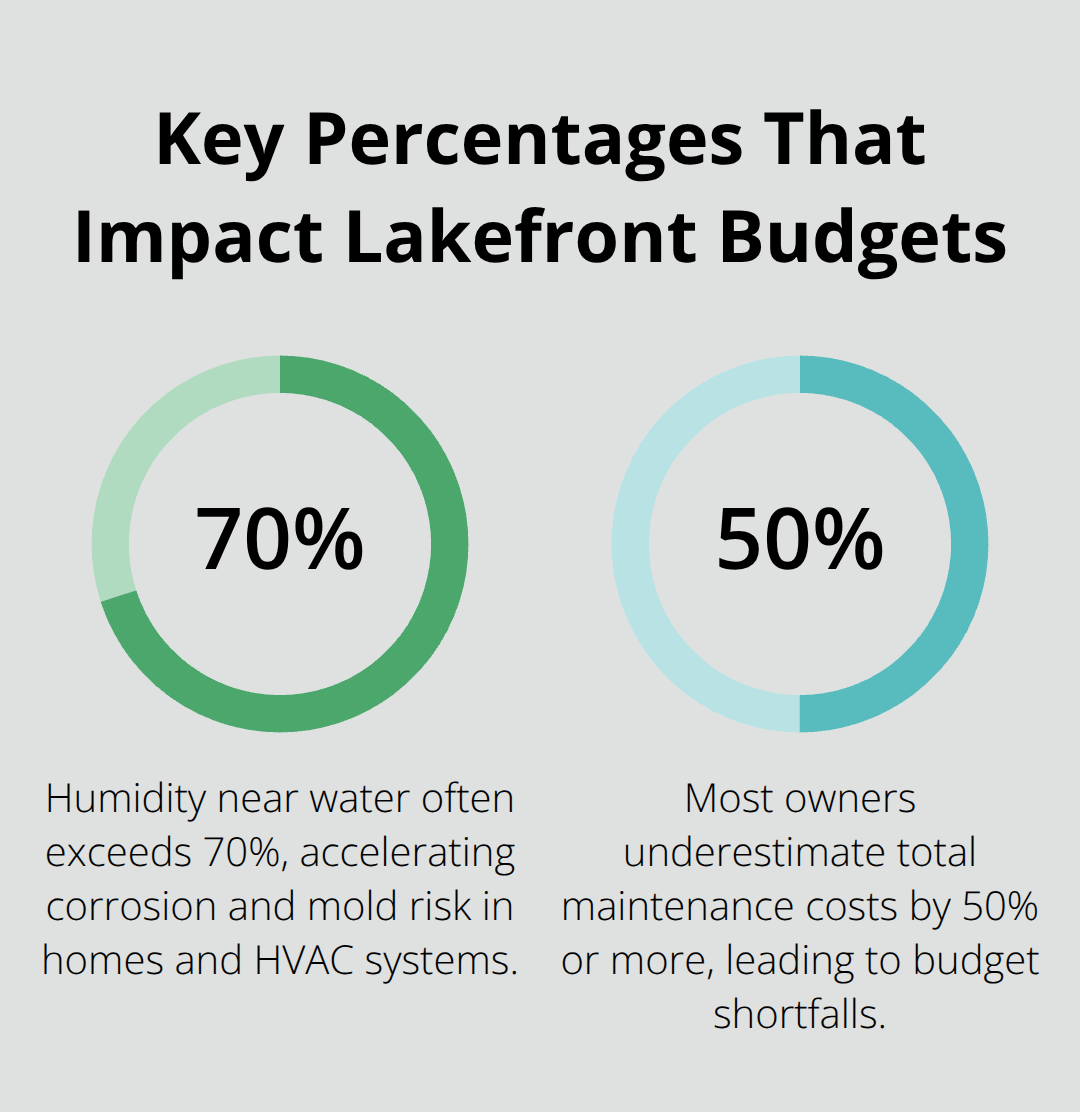
HVAC systems corrode faster in lakefront environments because salt spray, high humidity, and temperature swings stress equipment relentlessly. Humidity levels near water often exceed 70 percent, which accelerates rust formation on metal components and promotes mold growth inside ductwork. HVAC maintenance visits cost $150–$300 each, and lakefront properties need service calls four times annually instead of the standard two visits inland homeowners schedule. Condenser coils clog with salt and mineral deposits, forcing the system to work harder and consume more energy. Winter heating bills at lakefront homes run $300–$600 monthly on propane or natural gas, while electricity adds another $150–$400 monthly, totaling $5,400–$12,000 annually in heating costs alone. Full HVAC system replacement, which most lakefront homes face every 12–15 years instead of the 15–20 year lifespan of inland units, costs $3,000–$15,000 depending on home size. Dehumidifiers add another $50–$200 monthly to electricity expenses during humid months. Schedule HVAC maintenance before summer cooling season and before winter heating season, plus twice-yearly filter changes and annual ductwork inspection to catch mold and debris accumulation early.
Trees and Vegetation Create Ongoing Maintenance Demands
Trees near shorelines grow aggressively due to moisture availability, but their root systems destabilize banks and their branches overhang structures. Professional tree trimming costs $300–$1,000 per tree, and properties with multiple mature trees near the water spend $2,000–$8,000 annually on trimming alone. Falling branches cause roof damage ($3,000–$15,000 per incident), so preventive trimming pays for itself quickly. Steep grades around many lakefront lots make standard lawn equipment impractical, forcing homeowners to hire professional mowing services at $150–$400 monthly during the growing season. Invasive plant species like buckthorn and garlic mustard spread rapidly in lakefront environments and require professional removal costing $1,500–$5,000 depending on infestation severity. Native shoreline vegetation stabilizes banks and prevents erosion better than manicured lawns, but establishing native plants requires initial investment of $2,000–$6,000 for design, installation, and maintenance during establishment. The investment in proper landscaping management prevents erosion that costs $5,000–$40,000 to repair through seawall installation or riprap placement.
Final Thoughts
Lakefront maintenance costs add up fast, and most owners underestimate the total by 50 percent or more. Water damage, seasonal repairs, and specialized systems create a financial reality that extends far beyond the purchase price. A typical Northern Minnesota lakefront home demands $8,000–$20,000 annually for foundation protection, dock maintenance, seawall repairs, septic system care, HVAC corrosion management, and vegetation control.
Set aside 3–5 percent of your property value annually for maintenance and repairs, which means a $500,000 lakefront home should have $15,000–$25,000 budgeted yearly. Track seasonal maintenance schedules religiously: spring inspections after snowmelt, summer checks before storm season, fall preparation before winter arrives, and winter monitoring for freeze damage. Document all repairs and maintenance work to support insurance claims and establish patterns that reveal emerging problems before they escalate into expensive emergencies.
Professional property management eliminates the guesswork and catches problems early when costs remain manageable. We at Up North Property Management handle the full scope of lakefront maintenance for vacation rental properties, managing everything from seasonal inspections to emergency repairs, and our team knows Northern Minnesota’s specific challenges well. Whether you manage the property yourself or work with professionals, the reality remains unchanged: lakefront maintenance demands attention, planning, and investment.